
 |
| Bob Warner coming up to the Middle Peak of Mount Olympus. |
My right hand was deep in the cavernous interior of the Dana Designs backpack. This humungous load carrier had been the monkey on my back for the last seventeen days in the Olympic National Park, WA. I had frequently cursed the heavy load but could not deny that this was one helluva rucksack. Now, at the edge of the Blue Glacier, on a grassy slope drenched with sunshine at the top of Glacier Meadows, I was desperately seeking my own excreta which had been dutifully deposited into a ziplock plastic bag two days earlier. The ziplock had been liberally lined with a dessicating chemical powder issued as part of essential kit for the Outdoor Educator's Course run by the National Outdoor Leadership School (NOLS).
I had double packed the frozen turd in multiple black industrial grade polythene bags and buried the treasure deep in the backpack. Now it was time to dig it out and transfer it to the large garbage bin that the Forest Service had so thoughtfully placed on a small platform amongst the talus. My eight fellow trainees and two instructors had successfully completed their individual contributions to the communal crap heap and were rolling in the grass with laughter as I struggled to locate my poop. Finally, with a sense of relief, and sweat pouring down my sunburnt brows, I found the missing item, fished it out triumphantly and hurled it into the garbage bin! We had now made sure that human faeces would not mingle in the meltwater of the Blue Glacier and kept the NOLS pledge - Leave No Trace.
 |
| In the Hoh Rain Forest |
Then, for the first time in almost two weeks, we sauntered down the well maintained trail which would lead us over the next two days to the pick up point at the Hoh Rain Forest Visitor Center and thus end our 18 day sojourn in the Olympic National Park. As I marvelled at the tremendous girth of the Douglas Firs and the Red Cedars in this old growth forest, I realized how fortunate I had been to be a part of this course, without doubt one of the toughest physical adventures that I had ever embarked upon.
A little over a month earlier, as a new immigrant in Canada without a job, I was literally twiddling my thumbs when the telephone rang. At the other end of the line was Krishnan Kutty, an old acquaintance from Mumbai. He was calling from the Pacific Northwest Center of the National Outdoor Leadership School (NOLS) at Conway, a few miles south of Mount Vernon. Kris ran the NOLS India Programmes based at Ranikhet in the Kumaon Himalaya and was helping out the Conway faculty for the summer. He inquired about my health, my family, my prospects in Canada and then came to the point - "Would you be interested in doing a course at NOLS?"
 |
| Krishnan Kutty (left) and I on a walk on Table Mountain near Mt. Baker, 3 weeks before the NOLS course. |
It was an easy decision - I'd rather be honing my survival skills in some pristine wilderness than to be flipping burgers in a "survival job" (the euphemism used by career counsellors for new immigrants), which was the lot of most middle-aged newcomers to Canada.
Thus it came to pass that on the 7th of August 2002 I found myself at the Peace Arch border crossing.
The US Immigration Officer looked at my Indian passport and the multiple entry visa, glanced at me and said,"What brings you to the US of A?"
"I am on my way to Conway to participate in a course run by the National Outdoor Leadership School," I said confidently.
He cocked an eyebrow, looked at me again, looking for signs of "leadership" he might have missed initially, then said,"And how long will you be in the States for?"
"Well, the course is of twenty four days' duration, so I am looking at around four weeks".
He thumbed through the pages of my passport, shook his head, and then declared,"I need to see some documentation from the school you will be attending. You have a Type B2 visa.... not good enough for what you just told me. The school must have sent you a Form......" His voice trailed off into the cool morning air, I wasn't listening any more. I knew exactly what he was talking about. Of course I had that damn letter or form, it was yellow in colour and I had left it behind at home, assuming my B2 visa negated its requirement.
Fortunately, my home was about half an hour from the border. I turned around my old 1987 Chevy Corsica, sped back north on Hwy 99, retrieved the yellow paper, and turned up again at the officer's desk just as he was finishing his coffee.
By the time I checked into the NOLS campus at Conway, my course mates were already busy packing supplies for the trip. I was led into what looked like a lab with weighing scales and zip lock bags and marker pens scattered amidst bins full of granola, pasta, flour and other types of bulk food.
A cheerful female voice greeted me,"Hi, I am Brooke, one of your instructors." Her hair was tied in a pair of pigtails, she looked way younger than me (I was 47 at the time) and she sported a sunny countenance. As I was inducted into the packing process, I was gradually introduced to the 8 others I was going to spend the next few weeks with.
 |
| The group at the Gray Wolf river Standing Left to Right : Emily Turner, Diana Livingston, Sarah Bruce, Bob Warner, Brooke Moran, Jeff Kaphan, Martin Muendel. Squatting Left to Right : Jon Larsen, Aloke Surin, Andy Heath. Missing : Pamela Anderson who took the picture! |
It was an interesting mix of people from various backgrounds, ranging in age from 22 to 55. Emily Turner was the youngest, from the New York area, a keen skier and rock climber who was focused on making a career in the outdoors. Jeffrey Kaphan was around my age, soft spoken, also a ski enthusiast, and made a living in the jewellery trade. He lived in Colorado. Sarah Bruce was a school teacher from Toronto in Canada and was looking to add to her teaching skills. Bob Warner came from the Seattle area and had a very subtle sense of humour coupled with a deep sensitivity to native peoples. Jon Larsen was big, strong, tall, blonde, and lived in Portland, Oregon. For some reason I have not yet fathomed, he called me ADawg, and the name stuck. It sounded like the monniker of a rap artist with tattoes and festooned with jewellery - nothing could be further from the truth! By consensus, Jon was referred to as Jonny Rotten and he seemed to relish the title. Andy Heath lived in Portland, Oregon as well. He was the Quiet One, tall and seemingly distant; however, as we spent more time in his company, I realized he was the Wise One, carefully weighing his words before opening his mouth.
 |
| Andy, Pam and Sarah |
 |
| Diana below the summit rocks of the Middle Peak of Mount Olympus |
The TV serial Baywatch had been beamed a decade earlier to all corners of the globe and Pamela Anderson, the actress who played one of the lifeguards had attained a certain measure of fame, especially amongst the male population. So when this young lady with the dimpled smile introduced herself as Pamela Anderson, the shock must have shown on my face. Of course this was not the TV actress, but a cheerful soul from Medford in Massachusetts. Jonny Rotten and she would be my tentmates for the first part of the trip. I quickly learned not to aggravate her as she was a no-nonsense person who was not afraid to speak her mind.
 |
| Jeff (Photo courtesy Pam) |
Martin Muendel was the second instructor. He was tall and lanky and lived in San Francisco.
I probably had more high altitude experience than all the rest combined, considering I had been trekking and climbing in the Himalaya almost every year since 1976. But experience does not always count for much, as I was about to discover soon. I was an old Dawg about to learn some new tricks.
 |
| Emily on Cameron Pass |
 |
| Jon holds the cake that Brooke baked for him for his 25th birthday at the Base Camp of Mount Olympus. (Photo courtesy Pam) |
We were dropped off at Deer Park on the 7th of August and spent the night in the open. Each one chose a spot to his or her liking and settled down for the night. As I woke up in the morning, a black tailed deer crossed the gravel road and melted into the forest. It was a good omen for the beginning of the course.
 |
| Black Tailed deer at Deer Park campground |
Predictably, the topic chosen was How to Defecate Outdoors. On a forested slope of mountain hemlock, Jonny Rotten clambered into the dappled sunshine, his plastic mountaineering boots grinding invisible organisms into the earth and took up a suitable stance, one arm extended and braced against a tree trunk. Then he proceeded to execute a series of gymnastic moves in an awkward ballet, showing us a series of recommended postures to evacuate the contents of the human bowel. He ended his lesson with a Show and Tell segment - displaying leaves, pebbles, stones, twigs, clods of earth, moss, grass. These handy items, he told us, were the only accesories we really needed, in the absence of a supply of water, to clean up! Toilet paper, along with the other trappings of "progress" - like money, cellphones, radios, Walkmans, Discmans, etc. - had been left behind at Conway; I do believe that the instructors carried a roll of toilet paper to attend to cases in extremis!
To me, this was hilarious - I had spent the major part of my life in the Indian subcontinent where I had picked up these skills instinctively every time I left urban conveniences behind. On one memorable occasion, out in the rolling hills of Barutola in Jharkhand where my grandfather lived, a cobra had slithered towards me as I squatted in deep concentration and contemplation. Fortunately for me, the serpent made an abrupt U Turn and disappeared in the dry deciduous leaf litter, perhaps repelled by the stench of fresh human turd! For me personally it was a bigger challenge to hike in my Asolo high altitude mountaineering boots with a backpack that felt like it had been loaded with everything but the kitchen sink.
However, in the course of the next two weeks I began to appreciate the wisdom of cladding our feet in such sturdy, albeit awkward, footwear as we descended the scree from Cameron Pass on a slope delicately poised at what Martin reassuringly told us was the Angle of Repose, bushwhacked through dense undergrowth, balancing on the lower branches of dwarf trees and on a memorable evening crashing through ancient and decaying logs of Douglas Fir on our way to the Elkhorn camp on the Ehlwa River at almost midnight. We had made some navigation errors, had gone off course and were compelled to descend helter skelter in the dark to rejoin the main trail after a week of truly wilderness hiking.
During the rest day scheduled at Camp Wilder, Brooke taught us how to bake a pizza using the very basic supplies and equipment that we carried. Sarah and Emily, the other two in my new cook group (we rotated cook groups thrice during the course), manipulated the proceedings such that I ended up coaxing the yeast-injected dough to rise by placing the lump, cautiously encased in a thin cellophane wrapper, on my bare belly. As I lay supine on the ground, my body heat did the needful while birdsong filled this idyllic campsite. The resulting pizza, baked on our little MSR camping stoves, tasted better than any I had ever bought at Pizza Hut! Brooke is a wonderful teacher and I shall always remember her for this little cookery class in the wilderness. She had also pointed out a herd of Roosevelt Elk as they forded the Ehlwa a little downstream from where we were camped. The unique sight of these wild creatures, the quintessential symbol of the Olympic National Park, was for me a moment infused with a sublime magic.
Martin had an opportunity to show us his unique teaching skills as well. Camped on a high ridge he spent one morning carefully constructing a 3D model of a typical mountain with ridges and buttresses out of some mud and gravel. Then, to demonstrate one way to bring map reading to life, he carefully decorated the model with a series of strings to simulate the contour lines one sees on topographic sheets. I thought the idea was brilliant. On another memorable occasion, he had swept through our campsite just beyond Happy Hollow in the Elwha Basin, donning a cape like a comic book superhero and scattered the stuff that we had lying around untethered to demonstrate what havoc just a little breeze could do. Needless to say, the point was taken.
We had some great topo sheets to help us navigate through the wilderness, but little else. We had no access to a compass which made the task a tad more challenging and was probably the reason why we mis-identified the slope we were descending on our way to Elkhorn camp and ended up with some epic bushwhacking in the dark!
The culminating point of Phase Two of our sojourn in the Olympics was to ascend the middle summit of Mount Olympus. Since this was more than just a climb, but a Teachable Moment as well, it was drilled into us that as Outdoor Educators the concept of a Turnaround time was critical in mountaineering - in simple terms, you should use your judgement to ensure that you had enough time to descend a peak safely with your clients. The classic case study to demonstrate what could go horribly wrong if the Turnaround Principle was not adhered to is of course the disaster on Everest in 1996, recounted in Jon Krakauer's bestselling book Into Thin Air.
 |
 |
| The summit of the Middle Peak of Olympus. |
Mount Olympus is no Everest and the skies boded well as far as the weather was concerned. However, by the time our whole party had arrived at the bergschrund that gave access to the final rock pitch leading to the summit, we were well past the Turnaround Time that we had been agreed upon as a group. Brooke led off the rock with the rope trailing behind her and soon we could hear her yell for us to follow.
 |
| Brooke on the summit ridge. |
It was an awkward moment. My heart's desire was to step on to the top - too many summits had eluded me in my mountain journeys and a climb somehow never seems complete without the "closure" that the highest point provides. Yet again, I had given my consent to the group decision that if we were to go beyond the Turnaround Time, we would not continue on to the summit. I decided to decline with the rest.
Sarah was in a dilemma. She had come a long way from Ontario and the views of Vancouver Island and Mount Baker from the summit was a once in a lifetime opportunity for her. We could see that she was torn between the desire to show solidarity with us and this gorgeous golden moment of a summit opportunity. With what seemed like tears clouding her eyes and a voice choked with emotion, she said,"Sorry guys, but I just have to do this!" and set off up the rope to the top. We did not grudge her little triumph and I could understand her feeling. She was whooping with joy when she came back down.
 |
| Packed and ready to leave Base Camp. L to R : Andy, Emily, Sarah, Aloke (ADawg) |
 |
| Climbing up to Glacier Pass |
 |
| Teachable Moment in a crevasse! |
The rest of the course seemed like a vacation : a drive to Squamish in British Columbia, passing my home a few miles to the west as we drove into Canada on Highway 15 from the Pacific Highway border crossing, car camping for four nights at the Alice Lake campground a few kilometers north of Squamish, and rock climbing on the cliffs just north of The Chief (whose soaring walls constitute the mecca of rock climbers off Highway 99).
 |
| Jonny Rotten on the rocks! |
For the brief graduation ceremony on the lawns of the Conway center on a splendidly sunny summer day, each one of us was asked to present the certificate of completion to another trainee, prefaced by a little dumb charade which would identify the person who would be stepping up to receive the honors; no words were to be spoken.
It fell to the lot of Emily Turner to summon me. She hefted a huge backpack off her shoulders as we squatted on the cool grass. She opened the top flap carefully and began to take out its contents slowly. Clothes and knick knacks came out in slow motion. She stopped, peered into the depths of the backpack, and fished out more stuff. Her pace had quickened now and she was flinging things out of the sack in a panic. With sweat pouring off her brow, she finally held up a a black polythene packet in one hand while with the fingers of her other hand she pinched her nostrils shut and pretended to faint. While the others rolled with laughter, I rose to my feet to accept my diploma from her.
The Turd had come full circle!
 |
ACKNOWLEDGEMENTS
My sincere thanks to the following for making the NOLS Outdoor Educator Course an experience to cherish and remember for the rest of my life:
Krishnan Kutty
Brooke Moran
Martin Muendel
Emily Turner
Pamela Anderson
Diana Livingston
Sarah Bruce
Jeffrey Kaphan
Bob Warner
Jon Larsen
Andy Heath
Map sections depicted below from the Topographic Map 216 for Olympic National Park. Trails Illustrated Map / National Geographic. 2001 Edition.
A Very Special thanks to Keeley McFall from the NOLS Pacific Northwest who tracked down and sent me a copy of the complete route sheet taken by our course.
DAY 1 - Wed 7th August 2002. Drop off at Deer Park Camp Ground. Weather : Clear
DAY 2 - Thu 8th August 2002. Deer Park to Grey Wolf Camp. 8 miles. Weather : Clear
 |
| Deer Park to Gray Wolf camp |
 |
| Gray Wolf to Cedar Lake via Camp Ellis and Falls |
 |
| Jeff balances over a log bridge while Diana (left) and Martin (right) extend what can only be moral support! |
 |
| Diana pauses on the trail to Cedar Lake to admire the slopes flecked with Indian Paintbrush and other wild flowers. |
 |
| Cedar Lake. The only downside at this exquisite location were the swarms of bugs! |
 |
| The notch on the ridge is located directly east of the northern tip of Cedar Lake. |
 |
| Climbing up to the notch from Cedar Lake |
"Camp at approx 6000 ft, next to glacial lake. The trek across the ridge from Cedar Lake to this (campsite) was a steep uphill for about 1200 feet, with self arrest lessons thrown in. Mostly grass and heather, some snow, and lots of scree. The hike was led by Jon who did a wonderful job - taking in opinion and ideas from everyone present and going accordingly. It also helped that he is as strong as a bull.
This is a beautiful campsite, with snow fringing the lake. Our group seems to be going well, 3 days into the trek.
Some people are going up with Brooke (Bob, Jon and JK) to check out a high level traverse route across Mount Cameron tomorrow! I wish them luck."
Note: Jeffrey Kaphan was always referred to as JK.
 |
| Camp on Day 4 and 5. Mount Cameron at top right corner of photo. Glacial tarn out of picture to the left. |
DAY 6 - Monday 12 August 2002. Hiked up to Cameron Pass and camped on top of ridge SW of Lake Lillian. 2800 ft. height gain. 5 miles. Weather : Clear
There was a real scarcity of water at this spot, so I set off in search for the precious liquid while my two tent mates - Pam and Jon - organized the camp. I walked quite a distance along the ridge before finding a boulder strewn gully down which I scrambled before finding a solitary block of ice wedged between two rocks and which was melting ever so slowly. Positioning the water bottle so that the drip fell precisely into the container, I waited for almost an hour to fill up all our three 1 liter bottles! By the time I got back to the tent, Pam and Jon had already cooked dinner with our meager supply of water left over from the day, had eaten, and were fast asleep in their sleeping bags..... Jon grunted something to the effect that my portion of the food was still in the pan. Love's Labours Lost, I muttered to myself as I helped myself to dinner.
 |
| Lake Lillian is right of top center. |
 |
| Emily (right) and Martin reaching the crest of Cameron Pass |
 |
| Diana trudges up to the top of the ridge |
 |
 |
| Lake Lillian from the top of the ridge looking east and down. |
 |
 |
| Andy (left), Diana (center) and Jon trying to figure out the best way to Elkhorn. |
DAY 9 - Thu 15 August 2002. At Elkhorn. R+R. Weather : Clear.
DAY 10 - Fri 16 August 2002. Elkhorn to Camp Wilder. 9.5 miles. Height gain : 500 ft. Weather : Clear.
 |
DAY 11 - Sat 17 August 2002. Camp Wilder to a camp in the Elwha Basin beyond Happy Hollow. 8 miles. 1000 ft. height gain. Weather : Clear. This is where Martin demonstrated to us how a little breeze sweeping through the camp could easily make us lose critical items left loose and lying around!
DAY 12 - Sun 18 August 2002. Elwha Basin to Lake 4840' and Dodwell - Rixon Pass. 3 miles. 2200 ft. height gain. Weather : Clear.
 |
 |
| On the upper Elwha Basin, en route to Dodwell - Rixon Pass |
 |
| Emily (left) and Sarah drying out gear at Dodwell - Rixon. |
DAY 13 - Mon 19 August 2002. Rest day with a few lessons in self-arrest techniques on an adjoining snow slope and glacier travel procedures and safety protocols. Weather : Cloudy/Foggy.
DAY 14 - Tue 20 August 2002. Dodwell - Rixon Pass to Camp Pan on the East side of the Hoh Glacier. 3000 ft. height gain. Weather : Intermittent clouds/fog/whiteout in afternoon/evening.
What the log fails to mention is the initial descent from the pass, fording a fast flowing torrent at the bottom of the valley, then an epic bushwhack where the feet barely touched the ground, a rappel into the gorge which issued forth from the Humes Glacier, the trudge up the glacier in the late evening, and finally arriving at Camp Pan which would serve as the Base Camp for our climb of Mount Olympus!
 |
| Pam fords the creek while Martin spots her downstream |
 |
 |
| Laundry Day with Pam (left) and Diana at Base Camp, Mount Olympus. |
DAY 15 - Wed 21 August 2002. At Base Camp. R+R. Hold mock classes. Prepare for climb of Olympus. Weather : Clear.
 |
| I felt flattered when Brooke inserted this picture into the NOLS brochure for 2003 |
DAY 16 - Thu 22 August 2002. Climb Middle Peak of Mount Olmpus. Height gain : 2600 ft. Distance traversed : 8 miles. Weather : Clear.
DAY 17 - Fri 23 August 2002. Base Camp to Elk Lake via Glacier Pass and Blue Glacier. 8 miles. Height loss : 4000 ft. Weather : Clear.
 |
 |
DAY 19 - Sun 25 August 2002. Mt. Tom Creek to Hoh Rain Forest Visitor Center. Drive back to Conway. Freshen Up. Pick up Rock climbing gear. Drive to Alice Lake campground, north of Squamish, B.C., Canada.
DAY 20 - Mon 26 August 2002. Climbing on cliffs north of The Chief at Squamish
DAY 21 - Tue 27 August 2002 . Climbing on cliffs north of The Chief at Squamish
DAY 22 - Wed 28 August 2002. Climbing on cliffs north of The Chief at Squamish
 |
| A great layback crack |
DAY 23 - Thu 29 August 2002. Drive back to Conway with a brief stopover at Murrin Provincial Park where assessments were handed out.
DAY 24 - Fri 30 August 2002. Graduation. End of Course.
 |
| ADawg aka Aloke Surin |
 |
| The Dimpled Duo - Emily (left) and Pam (Photo courtesy Pam) |
 |
| Sarah, Bob and Jeff (Photo courtesy Pam) |
POSTSCRIPT
It has been 13 years since I completed the NOLS course. I do not know how many of the course participants actually sought a career in the outdoors. I do know that Emily works for Alpine Ascents International and Andy owns his own adventure travel company - Under Western Skies. As for me, Mount Seymour Resorts did hire me as a snowshoe guide for the 2008-2009 winter season. Janey Sea who interviewed me for the position seemed genuinely impressed that I had done the NOLS course. I worked only weekends as I had a full time job in the freight forwarding industry which paid my mortgage and my bills. It helps to get into the outdoor field when you are young, not when you are a ripe old 47 year old new immigrant in Canada! Unfortunately, most of the outdoor recreation industry jobs pay entry level survival wages on which you cannot raise a family.
I am now in my 60th year and in May 2015 an opportunity presented itself to revisit the Olympic Peninsula with my 25 year old son Jeremy. Jeremy loves to surf, so we headed out to camp at First Beach on the Quileute Indian Reservation at La Push at the northwest section of the Olympic Peninsula. On a beautiful spring day we also drove up to the Hurricane Ridge Visitor Center in the north east quadrant of the Olympic National Park. Black tailed deer grazed on the slopes below where the snow had retreated and the grass had turned a warm and mellow yellow-brown. Across the deep chasm of the valley rose the Bailey Ridge, and behind it, still higher, glistened the snows of Mount Olympus. It was an emotional moment for me as I gazed across the afternoon haze to those summits.
 |
| Olympus from Hurricane Ridge |
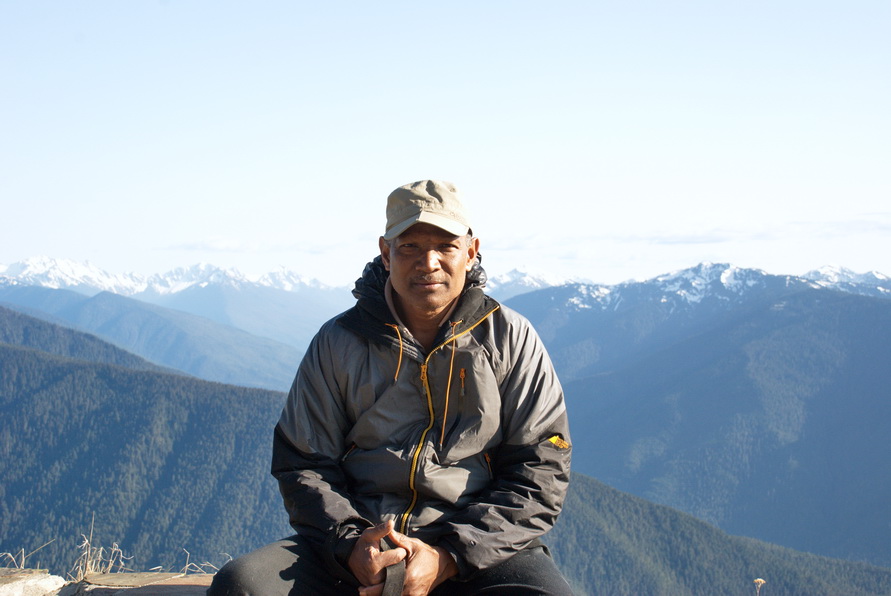 |
| Older but no Wiser! ADawg at Hurricane Ridge, May 2015. |
As a farewell, while Jeremy surfed, I drove up the Sol Duc valley to hike the short distance to the Sol Duc Falls. I arrived at the trailhead late in the afternoon and walked the 0.8 miles to the falls. The falls were a thing of beauty in that temperate rain forest and I was enchanted by the wildflowers that fringed the little brooks and streams that gurgled their way to join the Sol Duc river. Driving back from the parking lot a torrential thunderstorm broke over the mountains and I could barely see the road as I motored back. I stopped at the Salmon Cascades lookout just as the rain stopped momentarily. It was almost as if some divine power had given me this opportunity to gaze in awe and wonder at the torrent in the moist, fading light.
 |
| The Sol Duc Falls. May 2015. |
 |
| Salmon Cascades, Sol Duc Valley, Olympic National Park. May 2015. |
Tim McNulty wrote in 1996 in his book "Olympic National Park - A Natural History" (published by Houghton Mifflin Company) about the autumn migration of the coho salmon up the Sol Duc at this very place:
"As I lean against the wet rail of the overlook beneath dripping trees, first one, then another, then three salmon at once leap from a sudsing pool at the base of the falls. Kicking wildly,they fling themselves in arcs above the white rush of the torrent. Their dark flashing shapes, lit with a red underglow, seem to float almost motionless before falling and being swept back downstream. Above the falls in calm, spring fed pools beneath a forest of Douglas fir and red cedar lie the spawning gravels of their birth. It seems, amid the tumult of falling water, that few if any will make it past this barrier. But with thousands of years of adaptation to the dynamics of this very stream behind them, nearly all of them will..."
Like the salmon, my soul yearns to swim upstream through river gorges where the cold white waters from the snows of the high mountains swirls and froths; then leap the cascades to where my life must have surely begun.
 |
Suggested Reading :
The New Wilderness Handbook. By Paul Petzoldt (legendary founder of NOLS) with Raye Carlson Ringholz. W.W. Norton & Company, New York. First published 1974. Revised and Updated edition - 1984.
NOLS Wilderness Mountaineering. By Phil Powers. NOLS and Stackpole Books, 1993.


