The snow began to fall silently in the night again and visibility was still not very good at around a quarter to six in the morning. The sun finally broke through almost an hour later and with it emerged a positively charged Divyesh - he stomped all around the camp, boisterous and cheerful, and quickly dismissed any ideas that I may have harboured of lazing around another day with Roald Dahl for company. After a quick breakfast of cornflakes and tea we set off to climb Burphu South.
 |
| Satya coming up Burphu South. The Kalabaland Glacier flows in a wide arc below. |
 |
| Reaching the summit of Burphu South |
Narinder, Bhupinder and Divyesh led off on one rope while Satya and I followed more sedately, taking photos and looking across at Burphu Dhura's defences, seeking a line of weakness. We reached the top in about two hours, from where we could look at the entire summit area of Burphu Dhura head on. In between scudding, fleeting clouds, we were rewarded with brief glimpses of the mountain. After the usual heroic poses we descended via a different route, thus completing a traverse of this little summit.
 |
| Our route on Burphu South |
 |
| Divyesh on the summit of Burphu South |
Our return to Camp 1 coincided with the arrival of Soop Singh and Laloo with two large gas cylinders. After a lunch of macaroni I slid down the the fixed rope in the gully and switched it with a shorter one as we would need all the length we could muster for what lay ahead.
Finding a viable route on Burphu Dhura entailed descending about 40 meters east from our camp into a snow basin to reach the bottom of a snow gully. Over the next couple of days we fixed ten rope lengths up this in indifferent weather and in somewhat trying conditions, to achieve a 350 meter height gain.
After six days at Camp 1, I wrote in my journal for 4th October : "One more involuntary Rest Day! Winds and snow all night put paid to our plans of shifting to our "summit camp" Lunch, tea, soup, dinner flowed in one seamless chronology with lots of dozing in between..... Just finished reading the 3rd Roald Dahl story - The Sound Machine. Satya regaled me with stories of his travels and wanderings in the mountains.... the tent fabric flaps intermittently like a live thing."
Driven more by a need to do something rather than a rational assessment of the conditions, five of us (Jinendra opted to stay back) set out the next day to establish and occupy what we optimistically hoped would be Camp II. The final part of the gully was very steep and by the time we had hacked out a totally inadequate ledge for one tent and a shallow snow cave for Narinder and Satya (they volunteered!) it was close to 8 pm. We were cold, exhausted, dehydrated, hungry.
 |
| Route detail |
 |
| Traversing across to the base of the final rock gully to C2 |
 |
| Narinder, left, and Satya cheer themselves up with chai in their cave |
Divyesh, Bhupinder and I squeezed into the 2 person Hellman bivouac tent. I was the one on the outside and we spent a fairly cramped and gymnastic night listening to the howling storm. That night was one of the very few that I have spent in the mountains absolutely petrified, expecting any moment to be blown clean off the mountain and hurled down unforgiving cliffs of rock, ice and snow. Things were no better in the morning. We tried in a half half hearted manner to push the route up further but by the afternoon the storm came back with renewed vigour. Bhupinder, Narinder and I decided to descend, leaving the more optimistic Satya and Divyesh to spend another storm wracked night in the tent.
 |
| I stand outside our partially collapsed Camp 2 tent |
 |
| Narinder all set to go down |
A harrowing descent through deep soft snow in poor visibility was made all the more dramatic when thunder reverberated all around us and the wind carried spindrift through our shell jackets to chill our bones.
My downward progress can best be described as undignified. I would look for a place to plant my feet down the slope, then venture the lower limb into what I hoped would be a firm step, and often collapse in a clumsy heap, thankful for the fixed rope that I was clipped into. Slab avalanches coming off the nearby slopes added to the fear factor. The little snow basin which led up back to the camp was the most difficult to negotiate: the deep and soft snow ensured that movement was agonisingly slow. Thunder, wind, and more snow welcomed us as we reached the safe haven of Camp 1. We did not envy Satya and Divyesh their precarious perch higher up on the mountain.
Balwant braved the storm to deliver a piping hot mug of tea from the kitchen shelter and once again I was grateful that we had our hardy Kumaoni friends as support staff. Our lives would have been ten times more difficult without their presence.
The winds howled all night, driving snow up against the wall of my tent. I stared mesmerised at the logo of the manufacturer (Camp) of the rather flimsy shelter: the picture of the wolf was perhaps quite appropriate to the conditions we were experiencing but this was certainly not a tent suited for mountaineering. I longed for the more robust tents I had used in the past - like the North Face VE25 or the Wild Country Mountain Quasar. (Please note that this is not a paid endorsement, it is my personal opinion based on my experiences!). I expected the poles to snap and the wind to tear the fabric to shreds any moment.
 |
|
At the 8 am radio call on 7th October, Divyesh informed us that he and Satya were on their way down after a brutal night which he called "an epic for survival". We played cards in Narinder's tent while we waited for them. Duryodhan spotted them at around 11 am, descending the last of the fixed ropes to the snow basin. Narinder and Balwant immediately set out to relieve them of their loads and help them back to the tents. Both Divyesh and Satya had had a harrowing experience surviving the storm and were really glad to see Balwant and Narinder.
 |
| I watched (with a telephoto lens) Satya descend to the snow basin below Camp 1 |
 |
| Divyesh is all smiles as he reaches Camp 1 |
As if to mock us, the next day dawned clear and spotless, the rising sun in the east tinging the mountain silhouettes across the Kalabaland a tender pink. Perhaps the bad weather phase had come to an end and we were being presented with another opportunity. A thought occurred to me: we could try to climb all the way to the summit from Camp 1 and do away with the necessity of establishing an intermediate camp. The glorious morning encouraged such optimism and I voiced this aloud to Satya. We could wait out the day and if the weather held, make a go for the top on the morrow. He agreed, and so did Narinder and Divyesh.
 |
| We became transformed into peak paparazzi as the glorious weather engulfed us! |
But we were short on rations, so Jinendra and Bhupinder magnanimously offered to go down. We called Advance Base on the radio to send up some sugar,
dal and tea. Laloo and Soop Singh came up with those supplies and Duryodhan descended to organise porters for the return march.
 |
| Bhupinder and Jinendra bid farewell as they leave Camp 1 |
We spent the morning drying out, even managing to play a game of cards out in the open while soaking in the sun. Bhupinder and Jinendra left at 12:30 pm. The rest of us spent the afternoon putting our gear together and retired early for the night, hoping to make an early start.
I was awake at 12:40 am. The sky was clear and it was around -10 deg C inside my tent. That boded well for the day. After tossing and turning for about an hour I called out to Balwant (I could hear him talking to Soop Singh in their tent) to begin brewing the tea. This drink materialised around 2:10 am and was actually lightly flavoured coffee. At around 3 am they brought breakfast of "
dalia". After wolfing this down I began to get dressed and I could hear the others moving around in their tents as well.
Himalayan climbing can be summarised as a series of embarrassing situations punctuated by brief moments of sheer ecstasy. As if to prove this theory, my bowels sent out excruciatingly painful signals just when I had completed zipping up my salopettes. I fumbled with the zips, swore under my breath, and dived out of the tent with partly laced boots and ran clumsily as far as I could in the freezing cold to find a spot where I could safely stamp out a hole and deliver the contents of my stomach safely without contaminating the campsite! When I returned to the tent, I felt exhausted with the ordeal of dealing with my sudden loose motions. After regaining my breath, I continued the business of suiting up when Satya called out from the other tent. "Hey, Aloke, are you ready yet?"
"Give me another couple of minutes," I yelled back, struggling to strap on my crampons with fingers that felt like wood.
We left the camp at 4:45 am, Satya and I on one rope while Divyesh and Narinder shared the other. In spite of my down clothing and the Goretex jacket over it, I felt unreasonably cold. My headlamp kept slipping off my head and this made me increasingly irritated and frustrated with myself. We had barely begun ascending the first fixed rope above the basin when Satya began experiencing bile problems. He began to wretch and kept throwing up. After a while he said he thought that it was prudent of him to descend. I soldiered on upwards, still not finding a rhythm and still cold even an hour after the sun had risen. Divyesh and Narinder were moving well and fast and when I saw them becoming dots on the landscape I consoled myself by focusing on the gorgeous mountain views that were unfolding. If ever God had created the perfect day for climbing, this was surely one of them; I felt blessed just being able to soak in the magnificence.
 |
| The tents at Camp 1 looked like little dots as I climbed higher |
When I arrived at our intended Camp 2 site, I could see the tracks that Divyesh and Narinder had left. I followed and found myself sitting on a corniced ridge in a spectacular position, my feet dangling over the sheer drop into the Burphu Gad on the western side. The sharp ridge continued north towards the feature we had dubbed The Shark's Fin. I could see Divyesh and Narinder approaching its bottom. Once over the Shark's Fin, they would be in a fairly good position to continue on to the summit, as there did not seem to be any more significant obstacles. At least this is how it appeared from my perspective.
 |
| The upper section of Burphu Dhura as we had seen it from Burphu South |
This is Divyesh's account :
"
The route above the campsite required us to traverse the south ridge along its east face for 15m. We then broke through the cornice to get on top of the ridge till we reached a prominent shelf on the south ridge. This section was very tricky and Narinder did a fine lead. We fixed our last available rope on this section. The rope fell short of the shelf and we carefully belayed each other on the knife edged south ridge. The section took a long time to negotiate. We waited for Aloke at this point, hoping he would catch up with us soon. However he was not yet in sight and we had to make the decision to continue since we were now running out of time."
This same knife edge section now stopped me in my tracks. The snow stake that anchored the last rope to the ridge was now below me. From here onwards I would be on my own. I toyed with the idea of anchoring the rope that I carried in my rucksack to the stake and moving gingerly up the knife edged ridge. Then I ran a possible scenario through my mind: if I were to slip and plunge down the Burphu Gad side I would dangle helplessly, suspended by 50 metres of nylon and probably not be able to climb back up the overhanging face, assuming that I had not suffered any bodily harm during my fall. The thought sent shivers up my already cold spine. No, I told myself, that was not an option worth contemplating for a married man with a nine year old son. As far as I was concerned, The Shark's Fin was a Fin Too Far!
 |
| From my perch on the south ridge, I had this fantastic view of the Nanda Devi peaks (left) and the Hardeol group of peaks (centre) |
 |
| Nanda Kot (left) and Nanda Devi (centre) |
 |
| From left to right, Suitilla, Panch Chuli II, Chaudhara and Rajrambha were a feast for my eyes. |
So I made myself comfortable on the ridge, took a couple of pictures and began my descent. My prayers went up for Divyesh and Narinder to reach the summit safely and return. But it was not to be. Divyesh takes up the story once again :
"
Our next obstacle was the Shark's Fin, a steep icy feature on the ridge of about 150m. It dominated the route ahead. We soloed up the first 50m. The angle got steeper and the ice harder. We belayed each other up the next 100m till we were at the crest of the Shark's Fin. What lay ahead kept us gaping. A thin corniced ridge of about 150m snaked up towards the summit dome. This connecting ridge consisted of a shredded rock ridge covered by a few feet of snow and ice, plunging at several places and corniced alarmingly towards the east. To negotiate this patch would be a delicate affair and take considerable time. Since we had no fixed rope with us, it would also mean that we would have to spend as much time or perhaps more on our way back. We confronted the "mountaineer's dilemma". To advance or to withdraw, to overstep the fine boundary delineating courage from foolishness or to plunge forward heedless...... The summit was within touching distance, yet the time it would take to reach the top and come back to the safety of the fixed ropes might not be sufficient...... Finally I decided to be graceful in defeat and we retreated with reluctant steps.... We had missed our objective by a hair's breath..... Only 100m of vertical and about 200m of horizontal distance separated us from the summit."
 |
| Divyesh and Narinder on the Shark's Fin |
The IMF launched another two expeditions the following year to woo the Burphu bride. They followed the same route that we had pioneered. The team that went to Burphu Dhura in Sept 2000 finally managed to climb the mountain.
 |
| Overall view of our route |
On 27 September 2000, the summit was reached by Loveraj Dharmashaktu, Balwant Singh Kapkoti (the same Balwant who had accompanied us to Camp 1, his last name denotes the village of Kapkot where he hails from) and Ramesh. I sought a little comfort in the thought that they had reached the top on my 45th birthday!
 |
| Balwant Singh Kapkoti |
As we retraced our steps back down the valley, an autumn chill was in the air, the stream near Base Camp froze overnight and a solitary pika nibbled on the grass among the deserted stone houses of Ralam. Burphu Dhura and the Kalabaland would soon drape themselves in their winter garments and only privileged residents like the snow leopard and the lammergeier would have access to their splendour.
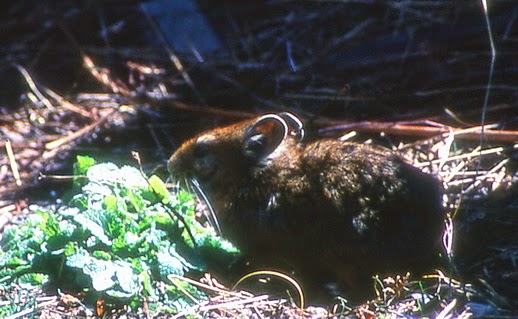 |
| Pika at Ralam |
Useful References:
1. "Mountain of Long Life" by Harish Kapadia. Himalayan Journal Vol. 36. Pg. 68. An account of the first ascent of Chiring We.
2. "Breathless on Burphu" by Lt.Cmdr. Satyabrata Dam. Himalayan Journal Vol. 56. Pg. 81. The official account of the 1999 expedition to Burphu Dhura.
3. "The Kalabaland Expedition, 1982" by Amit Bhargava. Himalayan Journal Vol. 39 Pg. 177.
4. "Two IMF expeditions to peak Burphu Dhura in 2000". The Alpine Journal 2001. Pg. 250.
5. The Scottish Himalayan Expedition by W. H. Murray (published in 1951 by J.M. Dent & Sons Ltd. London). Pages 225 - 238 recount the crossing of the Yankchar pass and the Ralam Dhura from Ralam to the Lassar Yankti and down into the Darma valley. Murray is one of the finest writers in mountaineering literature and the book is a classic of almost unfettered exploration of parts of the Garhwal and Kumaon almost sixty five years ago - decades before Google Earth, GPS and satellite imagery took the wonder out of discovering new worlds!
 |
| Harsingh Sr. A veteran of countless Himalayan expeditions, he made sure we never went hungry. He was equally at home churning out dal bhat or dishing out delicacies like gulab jamun at Advance Base! |
 |
| Duryodhan. He organised our porters. |
 |
| Laloo. |
Postscript :
Satya and Divyesh returned in 2002 to climb Suitilla. For Satya, Burphu Dhura was merely a minor bump in his quest for bigger challenges. He has since climbed Everest four times, skied both to the North and South poles, climbed on every continent on the planet, is part of the community of TED Fellows, and continues to inspire and regale audiences throughout the world with his talks. And yes, he did autograph for me a copy of his first collection of detective stories (Eyewitness), published in 2000.
For more on his exploits go to :
http://satyabratadam.com/
For one of his more entertaining talks, see :
www.youtube.com/watch?v=BgL1WnAVAeE
For a rather tame outing with him 13 years later see :
http://thappyfeet.blogspot.ca/2013/09/a-dawdle-with-dog-and-dam.html
 |
| Suitilla from the Kalabaland Glacier |
 |
| L to R : Divyesh Muni, Aloke Surin, Jinendra Maibam, Bhupinder Pant, Satyabrata Dam, Narinder Chouhan |
 |
| She spins wool..... |
 |
| .... while he gets to smoke! |


