Powered By Blogger
Showing posts with label Pulga. Show all posts

Saturday, 15 February 2014

Mantalai Magic - Part I : Getting There


"Are you serious, Si Lin?" I looked down at the vertical cascade of hard ice squeezed in between the tottering seracs and crevasses on our right and the rocky cliff dislodging the occasional rock like an artillery shell on our left.

Si Lin's face erupted in a huge grin. "Don't worry, Aloke, we'll be down and up in a jiffy."

Hu Si Lin
He struck me as an irrational optimist. It was bright and sunny and the frost was already loosing its grip on the loose rock. Even a small barrage of stones hurtling down the chute would kill us instantly. Si Lin was a dentist from Vasai near Mumbai and I was confident that he could easily extract my teeth, but would he be able to extricate himself (and me, for that matter) if a couple of hundred tonnes of rock and ice buried us? I should have stood my ground and gone the long way round to retrieve the load that he had dumped a couple of days earlier on the northwest branch of Glacier IV at the head of the Parvati Valley in the Kullu Himalaya.

The next 30 minutes were perhaps the most frightening I have ever spent in the mountains, rappelling off a couple of ice screws into the labyrinth, expecting any moment to be flattened by a boulder on its way down the cliff. I belayed Si Lin on the last section as he finally emerged from the ice fall onto the gentler snow slope and found his cache. He then insisted that we return the same way to the camp below the peak of Parvati South where the rest of the team were enjoying their late breakfast.

We had just taken a decision which by no stretch of the imagination could be classified as a Calculated Risk. I told myself that I should recommend Si Lin for a course in Risk Management in the Mountains. In the meantime I was stuck with him as my climbing partner on the Parvati-96 Indo-American Himalayan Expedition. Though the title was quite a mouthful, with 15 members it wasn't hard to swallow!

The team at Base Camp
Standing L to R : Raghu Iyer, Prakash (cook), Inder (cook), Jaspal Chauhan (Liaison Officer), Steve Cox, Natala Goodman (holding on to the dog Blackie), Franklyn Silveira, Ajay Tambe, Donald Goodman, Prabodh Ganguly, Howard Weaver, Shridhar Nivas.
Sitting L to R : Jim Tweedie, Dinker Shah, Mike Burns, Aloke Surin, Karen Close, Hu Si Lin
When I  returned from Chango in 1995 (see http://taccidental.blogspot.ca/2014/01/the-chango-chronicles-1995-grip-on.html ) I found a letter from the Himalayan Club enquiring if I was interested in being part of a joint expedition with The Mountaineers of Seattle. Little did I suspect that the unenviable task of "Leader" would be foisted on me. Don Goodman, a long standing member of The Mountaineers, was living in Mumbai at the time and had suggested to the Himalayan Club that an Indo-American expedition might be a good idea. I had first seen Don when he was giving an illustrated talk at the Himalayan Club about a hardcore ascent of Mt.Foraker in Alaska. I also knew that he had been to Everest and some seriously high peaks around the world, lived in Seattle and had hiked and climbed extensively in the Cascades, Alaska and Canada. He was eminently more suited than me to head the team, but due to the bureaucratic requirements of the Indian Mountaineering Foundation for joint expeditions, I became the Accidental Leader! 


Steve Cox

Steve Cox from Seattle would function as Joint Leader. Since Steve and I were separated by a couple of continents and an ocean, it fell to Don and me in Mumbai to co-ordinate the arrangements in India. Don and his wife Natala were easy to get along with. Both were so imbued with the spirit of adventure that in their very first few months in Mumbai they had ventured to drive out to Khireshwar at the base of Harishchandragadh, knowing not a word of Marathi or even Hindi and hiked up to pitch their tent on the vast plateau on the fort in the midst of the monsoon!

Don is a man of a rather generous build matched by an equally generous nature. He is armed with a great sense of humour and a loud, infectious laughter. We chose the Parvati valley in Kullu because it did not require the reams of paperwork that areas designated within the Inner Line demanded. Glacier IV at the head of the valley had been well documented by a few pioneering teams and provided access to a number of peaks with modest heights and varying degrees of difficulty and we agreed that it would provide the perfect playground for our mixed bag of members.

The whole team, barring Prabodh Ganguly, gathered at the Indian Mountaineering Foundation's complex in New Delhi and after the appropriate meetings, briefings and much handshaking with the Director we loaded up the bus that had been hired to transport us and our baggage to Manikaran, the road head.

During the stop at Kullu, while the rest were enjoying brunch, Don, Steve, Jaspal Chauhan (the Liaison Officer) and I went to pay our respects to the District Magistrate. This courtesy was not only formal, but ensured that the local authorities were in the loop if a mountain rescue had to be organised.


Late in the evening of 11 September 1996, we arrived at Manikaran where Prabodh was waiting. He had booked a couple of rooms in the rather less than luxurious Amar Guest House whose tacky signboard announced "For comfortable stay and have a special guide if needed"! We assured the owner that we already had our "special guide" - Chaman Singh Thakur from the village of Raskat. I had met Chaman for the first time in 1991 during a trip to the Dibibokri - see http://taccidental.blogspot.ca/2013/09/dibibokri-dreaming-part-1-freedom-of.html and http://taccidental.blogspot.ca/2013/10/dibibokri-dreaming-part-2-icing-on.html

The route from Manikaran to Mantalai
Ignoring the superstitious overtones of Friday, 13th September, the expedition crossed the wooden suspension bridge over the Parvati river and wound its way up the trail towards Raskat and Pulga. I sighed with relief as I saw the 68 people dissipate, some in groups and some alone, up into the mountains. We had 49 porters,  the 2 cooks Inder and Prakash, Chaman Singh, in charge of them, and the Liaison Officer. I had never taken to the hills with such a big team and I wondered what lay in store. Dinker Shah, a retired engineer from Ahmedabad was the oldest member at 62. Mike Burns hung around climbing walls in Seattle and was the youngest at 26. Karen Close, Jim Tweedie, Steve Cox and Natala Goodman had extensive climbing experience in the Cascades. Howard Weaver, a teacher by profession, had lost count of the number of times he had climbed Mount Rainier. Don had an enviable track record of high altitude mountaineering.

Dinker Shah
Shridhar Nivas was a Master Mariner but this was his first climbing expedition. Ajay had been on a few Himalayan trips, including our first visit to the Chango glacier in 1993 (see http://taccidental.blogspot.ca/2014/01/the-chango-chronicles-1993-first.html). Raghu and Franklyn were to confine themselves to trekking up to Advance Base. Prabodh, from Calcutta, had only a few weeks earlier been climbing a peak (Kangla Tarbo II) in Spiti which was just north of the Dibibokri-Parvati divide. He had made the excellent arrangements for the Rest House at Pulga, navigating the corridors of the Forest Department to accomplish the task. Our mandatory Liaison Officer, Jaspal Chauhan (he preferred to be called Bally for some obscure reason), was a young lad from the town of Uttarkashi in Uttarakhand. He was a little surprised and offended that he had not been consulted in the hiring of the porters, a task the L.O. is normally entrusted with for foreign expeditions. I had to explain to him that since Chaman Singh was an old friend of mine, the process was already a fait accompli and he should consider himself fortunate that he had been relieved of an onerous chore.

The Parvati flows through a gorge beyond Pulga
Like any classic approach march, this one was to be enjoyed to the hilt, starting off with meeting Chaman's family at Raskat and waving to the schoolchildren, halting at the wayside tea shops, and pausing every now and then to admire the view or to take a picture. Walking unhurried in the mountains is the perfect balm for the stressed out urban soul.

Natala and Raghu at a chai stop
As each of the porters walked into the compound of the lovely Forest Rest House at Pulga, his load was ticked off on a list and he would wander off to be with his mates. They formed little groups and lit small fires to cook their evening meal while the sunlight faded from the peaks high above.


A guest entry in the register of the Pulga Rest House, 81 years before us! We were amazed that the ink and paper had survived so long...
The approach walk which can normally be accomplished comfortably in 5 days stretched out to 6 when six of the porters deserted us at Tunda Bhuj over a dispute over "double pay". It was a small lesson in the logistics of handling a large (in my limited experience) expedition. The misery of the cold rain en route to Khirganga was thankfully compensated for by a dip in the hot sulphur springs there.

Shridhar arrives at Khirganga, ready for a dip in the hot springs
The open meadows beyond Tunda Bhuj and Thakur Kuan were a welcome change from the damp forests as was the sunshine. At Uri Thach we stood around in a cold wind, holding our daily status update meeting even as the sun set in a spectacular display of orange and shades of burgundy and maroon. Across the river we could make out the tents of the Scottish expedition which was busy on the flanks of Kullu Eiger which rose in an impressive sweep of steep rock.

Kullu Eiger - 5664 m
Finally, on the 18th September we crested the moraine dam from which issued the nascent Parvati river and passed the shrine with its trident. We walked for an hour more and finally forded the now shallow Parvati stream as it flowed in the wide floodplain of Mantalai and established our Base Camp on its true left bank. The large kitchen tent went up next to a tall boulder and a pit toilet was fashioned in the middle of a group of large rocks: the Parvati 96 Indo-American Himalayan Expedition was open for business!

The last lap to Base Camp

Base Camp
A pastoral idyll en route to Khirganga


Sunset at Uri Thach


Saturday, 14 July 2012

Sara Umga Pass - Manikaran to Shamshi Thach

Everything reeked of ghee! The tent, my clothes and the food were all plastered in a sticky film of clarified butter. The ghee container had come apart inside the kit bag in which it was packed, spilling its contents liberally over everything that was inside. The kit bag had been loaded by Bir Singh on top of the Manali - Manikaran bus and had succumbed to pressure from the assorted luggage of all the passengers crammed into that tiny bus.

We had boarded the bus at 1:15 in the afternoon at Manali. The 40 km drive to Kullu along the Beas river was very picturesque and I revelled in watching stretches of this wonderfully ice blue torrent as it hurtled along this green valley. It was almost 7 pm by the time we arrived in Manikaran in the Parvati valley. Manikaran struck me as a dirty, nondescript little village. We found accommodation for the night in a little tea shop. We opened up the kit bag with the spilt ghee and proceeded to clean up the mess in the little den that had been allotted to us as our sleeping quarters. The place was full of, for want of a better word, "hippies". I use that term rather loosely to describe an undistinguished assortment of westerners (mainly from Italy and Israel) who seemed to be drawn to Pulga in the Parvati valley for its cheap and abundant supply of marijuana. Even as far back as 1985 this influx of pot smoking rebels was having a negative effect both on the economy and the mores of this Himalayan valley.

Our concern however was not so much the supply of weed as the supply of fuel for our little expedition. We had failed to find any kerosene for sale in Manali and Bir Singh had assured me that we would have no trouble finding some in Manikaran. Alas, it was not to be so. With the prospect of perhaps not being able to have any hot foods or, more importantly, hot chai on the trip we set off posthaste up the trail towards Burshaini. It was hot at first because of Manikaran's low altitude (around 4000 ft) but improved as we proceeded up the valley.


 I was impressed by how green everything was here: my eyes had become accustomed to the rocky vistas of Lahul. In contrast, the evergreens clothed the steep slopes here on all sides, waterfalls gushed out of rocky clefts high up on the mountainsides and cascaded down in energetic displays of  aquatic energy; sometimes the sunlight caught the spray at the right angle and behold, a rainbow was born! All these sensory delights could be better appreciated when we finally managed to buy 2 litres of kerosene from Thakur Beli Ram in the village of Tahuk. This kind gentleman also offered us tea and apples which we gladly accepted; in return all he wanted was that we take a photograph of him with his family.

Bir Singh with Thakur Beli Ram and his family who sold us kerosene in the village of Tahuk
In those pre-digital camera days one often came across folk in remote villages in the hills for whom a photograph was a great document, to be treasured and shown to family and friends. I always made it a point that if I took any pictures of kind and hospitable people in the mountains I would write down their postal addresses and mail them a copy of the photo once I returned to Mumbai. I have no idea if all of them ever received my photos, I know some of them did and they would happily pull out the prints and show it to me if I was ever to revisit their village at a future date. I would like to think that most of them did receive the packets I sent them, sometimes by registered mail if that was an option available in their neck of the woods. Small gestures can make a big difference to people's lives...

We made another small halt at Burshaini, the last permanent village in the Parvati valley, to stock up on some rice, sugar and onions. A little while later we turned left up the valley of the Tos river which drains the high glaciers of the Kullu - Lahul divide in this part of the range. Half an hour up the valley we found the ideal campsite and decided to stop for the night. My journal for Sat 7 Sept 1985 reads:

"We are camped on a beautiful grassy patch with pine trees around us and a clear stream flowing by next door....Looking out of the tent door I can see some goats and sheep which some gaddis have brought down from the higher pastures. Incredibly, they have lit a fire in the middle of a small ploughed field even as it is drizzling continuously...Am feeling very smug inside the tent : the temperature is a very comfortable 19.8 deg C and my tummy is full of a huge helping of rice and potatoes and onions which we fried together in the pressure cooker with mustard seeds, jeera, and pepper powder and eaten with red chilli pickle. Before that we had tomato soup...and before we pitched the tent we had tea and hot (as in chilli hot) banana chips."


Bir Singh ensured we were well fed at all times!


I justified this sumptuous repast by reminding myself that it had indeed been a long haul from Manikaran with our heavy loads and, what the hell, I owed it to myself to regain some of the weight I had lost on the Lion climb! When it comes to food, Ravi is a frugal soul. Now, free from his critical gaze, I could indulge myself!


Later in the evening we had a visitor : a gaddi coming down from the pastures above dropped in to say hello and it transpired that Bir Singh and he had some common friends in Bhuntar, near Kullu. Perhaps this prompted the gaddi to gift us some more potatoes which we accepted gracefully. He told us that there were around 10 people camped at Shamshi Thach whither we were bound.


Before turning in for the night Bir Singh asked me for the copies of the articles and maps I had made regarding the Sara Umga La and pored over them with keen interest. He seemed to be genuinely interested in seeing the topography around us depicted in the two dimensional format of sketch maps gleaned from old issues of the Himalayan Journal. I did not have any Survey of India topographic maps of the region as they were "Restricted" under the archaic regulations then in force. I translated as best I could some portions of accounts of the early explorations of the Tos glacier and climbs of Dharamsura and Papsura.


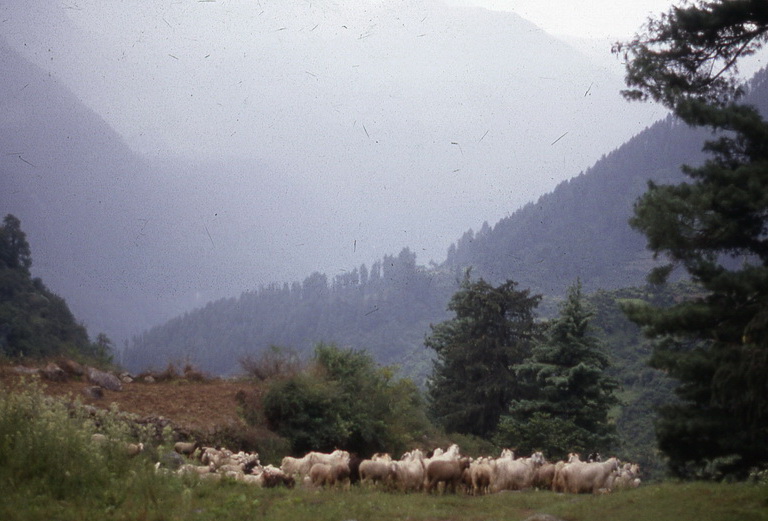
A bout of steady uphill walking in intermittent rain the next day took us through the clearing at Budhaban where some enterprising souls were growing marijuana, up through forests of pine and deodar until we came upon a settlement of buffalo herders from Mandi in the lower hills of Kullu. They leave their animals up here for the duration of the summer to graze on their own and come to collect them as the season ends. With charming ingenuousness Bir Singh asked them to give us some lassi and they were happy to oblige. The concoction tasted sour but was extremely refreshing.


The tree line soon thinned out and gave way to rhododendron bushes as we ascended the true right bank of the Tos Nala. A hailstorm broke over our heads as we waded through meadows of wildflowers carpeting the hillside and magic filled the air. Finally, six hours after starting that morning we found another lovely campsite : Phanjura Losha Thach, according to the local intelligence. There was a small stone shelter where we huddled on arrival to brew some chai: it was getting chilly and the altitude was beginning to manifest itself. A small, brown and furry pica appeared from within the gaps in the rock and looked at us quizzically and disappeared in a flash, too shy to be photographed.

Marijuana shrub at Budhaban

As I settled down in my sleeping bag after a fine repeat of the previous night's dinner menu, Bir Singh went back to studying the reference literature on the area that I was carrying. As I watched him absorbed in the print, it occurred to me that  lads like him in the Himalaya would make excellent mountaineers given the means and the opportunity.


The next day's walk was a long steady haul, not very steep but the the gradual ascent slowly introduced us to the grand mountain vistas of the Tos and East Tos glaciers unfolding before our eyes and behind us across the great gap of the Parvati valley. Bir Singh's instinct led us to the small encampment below Shamshi Thach of two gaddis from Palampur. We were greeted by Nandlal, one of the two shepherds, and his two dogs TC and Sheny. The gaddis were cooking their lunch of rotis and I suspect it was the smell of this that had led Bir Singh up here! I am sure he was hoping for an invitation, this would save him from cooking for us....his instinct proved right: we were soon enjoying rotis and goat's milk sweetened with "gur" (jaggery); it was delicious!


Suitably fortified now, we forged ahead with renewed vigour. We hauled ourselves up the grassy ridge until suddenly the terrain opened up to a huge flat plain crisscrossed with innumerable streams: this was Shamshi Thach, the base for climbing Papsura and Dharamsura and for any forays into the nearby valleys and glaciers. We could see a couple of tents scattered around the meadows and we guessed these must belong to the two expeditions which were camped here. We identified a suitable spot and began to head towards it. A rather large stream coming in from the left barred our way, so we linked hands for stability and security and began to ford the fast flowing water. As if by magic, a couple of figures emerged from the tents and clutching cameras in hand they made a beeline for the far shore to photograph us as we wobbled in the knee to thigh deep current. I am sure they were hoping for a dramatic moment when one of us would lose a footing and get a thorough dunking! We were sorry to disappoint these folk and they cheered when we made it to their side unscathed.


Base Camp, Shamshi Thach


Shamshi Thach with the prominent stream running through. As seen from the East Tos Glacier

There were 2 Australians and 3 Britons camped here, with their respective Liaison Officers. After we had set up camp we went around to meet them. Ravi Chandra from Mysore was the LO for the Aussies while Commander Sood of the Indian Navy accompanied the Brits. The Aussies were hoping to climb Papsura while the Brits hoped to ascend Dharamsura. All I was hoping to do that evening was hike up the boulder strewn valley above the camp towards the Malana Glacier for a glimpse of the impressive peak of Ali Ratni Tibba, which Ravi had attempted in 1978 with his friends Jayant Khadalia and Ravish Puri. It was after dinner and getting dark at 7 pm when I crested the ridge, expecting to be rewarded by The View. I was sorely disappointed.

Not having seen Ali Ratni Tibba, I began to descend. The light was tricky and rapidly turning dark and I foundered around, stumbling and falling on wet patches of moss covering the boulders. It was certainly not a dignified performance and I was glad no one could see me. I soon began to lose my bearings. Fortunately, Bir Singh had lit a candle inside our orange tent and the glow from it turned out to be the beacon that led me back to safety. I was looking forward to the next 2 days at this camp which would give me ample opportunity to look around and get the lay of the land. In present day parlance, I was just gonna chill, dude!