Powered By Blogger

Saturday, 27 April 2013

Brahmmah - Man Proposes, God Disposes.

Pulse Rate : 80
Blood Pressure : 84/120

Doc Krishna Mohan sighed. I knew it was not a good sign, but I was used to it. He would take our readings every day that we were at Base Camp, but I noted it down in my diary just the one time: he was only confirming what I had known all my life - that I was no athlete. In school, I would trail behind all the other boys in the simplest of races, and therefore I never took any interest in competitive sports. Hiking and climbing mountains (or at least trying to!) appealed to me as a form of Do It At Your Own Pace activity which would not embarrass me in public. I know that climbers can be extremely competitive in their own way, but I certainly did not belong in that category. At the same time, was I being presumptuous to tackle mountains perhaps I should not even be near to? The motivation to climb is very hard to pin down: it is based on personal feelings and perceptions and fuelled by individual desire. For me, personally, the location of a peak played perhaps a greater role than its difficulty in being chosen for a visit. A little off the popular list, a little less attempted, not too remote (if I had all the time and resources in the world, this would not be an issue!) - these were attributes I looked for when planning a mountain holiday. I may not have been very successful as far as climbing to the summits was concerned, but I always came away with a sense of having spent a few weeks in stunning landscapes with close friends and having experienced that high that only big mountain elevations seem to dispense to their devotees.

Over the next couple of days we had managed to establish a camp at the foot of the Brahmmah ice fall. The route crossed the interminable moraine of the Brahmmah glacier diagonally from Base Camp and then ascended the last stream flowing into the glacier from the other side. This gave us access to a beautiful ablation valley where we could rest from our labours briefly amongst the wildflowers and the tarns that adorned its hollows.

Looking up the ablation valley as it turns into the southern cwm of the Brahmmah Glacier


From here we turned into the southern cwm of the glacier and were instantly confronted by the sight of the towering wall of the ice fall which cascaded from the peak. The summit soared up for about 7000 feet above the Advance Base Camp as we chose to call our small cluster of three tents. Initially the south east ridge plummeted sharply  from the summit for about a thousand feet before being brought to a halt by the three prominent rock pinnacles. From here, the ridge descended rather more gently to the col between Flat Top and Brahmmah. Our goal was to place a camp on the col, just as all our predecessors had done. To gain the col, we planned to more or less follow the route pioneered by the first exploratory Cambridge-Indian Kishtwar Expedition in 1965.

Route from Advance Base to the col

The South East Ridge of Brahmmah  on the left

However, the best laid plans of mice and men and mountaineers do go awry : we had to contend with my sudden bout of fever, Kamlesh's painfully blistered feet, and Faruk's leg injury which sent him scurrying to Base Camp for a rest. Fortunately, bad weather also moved in, justifying the hiatus in our activities. In the meantime, two Australian brothers (Tim and James Strohfeldt) had arrived at Base Camp; they were hoping to ascend Brahmmah via its North East ridge route where a couple of years earlier some Japanese climbers had perished. They also wished to climb the Eiger and would spend days gazing at its steep granite walls with their binoculars while listening endlessly to their Walkmans : they had no power problems as they had come equipped with portable solar chargers for their Handycams and other gadgets. We, on the other hand, had to coax life out of our batteries by regularly inserting them into our armpits!

Advance Base Camp

Looking down at the moraine of the main Brahmmah glacier from Advance Base.
Shashi spotted a bear one day on the green slopes at the left hand side of photo.


There were other differences between them and us. While they apparently had quite substantial experience in lightweight alpine style and big wall climbing, our motley crew were all amateurs united only by a common love of the mountains. Our climbing style was cumbersome and burdened with too much weight. And our relatively lower levels of fitness and climbing skills put the "Fast and Light" style probably out of our reach. However, adequately nourished by Shashi's great cooking, we soldiered on and after a series of hiccups, Faruk and Harsha occupied the col camp on 5 Sept. They had taken 9 long hours from our Advance Base: we had watched them all day ploughing up the interminable slope, Faruk finally breaking through the cornice on the top and disappearing from our sight.

Faruk and Harsha en route to the col camp


Two days later Ravi and I took an hour longer to do the same stretch! We were caught halfway in a snowstorm. Ravi wanted to stop and camp but the prospect did not appeal to me as we had no stove! I reasoned with him that all we had to do was follow our friends' footsteps. Even so, it was a memorable day. Here is an extract from my journal: "...we started off at 1430 (we had left Advance Base at 0900) up the ever steepening slopes in the ever increasing whiteout....It was 1900 hrs by the time we dragged ourselves to col camp, tired, exhausted, stunned into utter silence by the cold. Faruk made some drinking chocolate which brought back life to us."

The col camp was fabulously situated: to the south we could look down into the Kibber Nullah. To our left the ridge went snaking up towards Flat Top whilst to our right the south east ridge of Brahmmah could be viewed almost head on.

The col camp location  as seen from the south east ridge

Looking south over the Kibber Nullah


Flat Top (6100m)  from the col.

Three and a half thousand feet separated us from the summit. In August 1973, Chris Bonnington and Nick Estcourt had reached the summit in nine hours of climbing, bivouacking on the way down at approximately 20,000 ft. Not considering ourselves in the same league, we decided to establish another camp a little higher on the ridge from where we hoped we would stand a better chance of reaching the top. We found traces of old fixed ropes in many places, evidence of the passage of past climbers.


It was already three weeks since we had arrived at Base Camp; and only two weeks for Ravi who had joined us later due to his business commitments. We had had our fair share of setbacks and rain and snow and illness and injury. But as 13 Sept dawned, we felt that all that was behind us and that the gods would finally relent. We prepared to push for the summit and were set to bivouac either on the way up or down. The dawn sky emerged clear, but this was deceptive. As we reached the first of the rock towers on the ridge the western horizon changed rapidly, massing dark cumulus clouds. Snow pellets began to rain down on us and soon flakes began to fall all around us as we groped our way on the rock. Visibility began to fade and with it our hopes as well. We were cold and tired and exhausted after weeks of effort. As the snow accumulated on the ledges and spindrift blew into our nostrils we deemed that retreat was the logical decision. Self preservation is a great instinct and perhaps this prevented us from being out on a limb on very steep terrain where misfortune could so easily have befallen us.


Harsha, Faruk and Ravi climbing up the southeast ridge.


Faruk belays Ravi near the pinnacles.
We scurried back to our tents in driving snow.

Over the next couple of days we came down off the mountain, chastised. At the Advance Base, a German climber Ewald Ruff had arrived. He was accompanied by Tariq Ali. They had trekked in from Srinagar over the Margan Pass and were planning to cross over the col into the Kibber Nullah and into Kishtwar. Ruff seemed to lead a charmed life : he had climbed Ama Dablam solo in Nepal. The 53 year old had been coming to the Himalaya every year for the last 29 years, making a living by guiding treks and making telefilms. We watched them climb to the col in six hours on a perfect sunny day and disappear over the top.

The Australian duo were also in residence at Advance Base, having failed to climb the north east ridge. Now they had settled for the south east ridge and there was no more talk of climbing the Eiger! They too were to fail on the south east ridge after we left.

Kamlesh bids farewell to the Aussies' Liaison Officer

Shashi shamed us all into humility as he raced back to Base Camp over the moraines, shod in his favourite leather boots more appropriate to city pavements than to the unstable boulders of the Brahmmah Glacier. We could not keep up with him and were happy to fall back and look over our shoulders to our home of snow and rock for three weeks. The colours of the grass and flowers and leaves was like a tonic to the eyes,  fed on a limited colour spectrum for too long.

The pack ponies ford a stream as we head down the valley


The walk back down the Nanth Nullah was as intoxicating and heady as it had been on the way up: in fact Doc Mohan and I meandered off the track, lost in conversation and soaking in the visual delights. It was getting dark when we groped our way to a gaddi encampment. One of the shepherds offered to escort us to where the rest of the team was spending the night.

The night was cool and starry and I found a great spot under a boulder to snuggle into my sleeping bag. That night was one of the best sleeps I had had on the whole expedition and for this small pleasure I was grateful. A mountain trip is always replete with moments of simple abundance, and I guess this is what drew me back time after time to the hills.

Kamlesh (right) and I seriously consider a shower!


"16 Sept. We trekked down to Haunzar and bathed in the sulphur springs," my journal reads. "...had tea at Sueda, chicken curry rice at the Fauji's stall in Sonder and hobbled into Ekhala in the evening, dog tired after a very long 11 hour day.." A bottle of rum passed hands and spirited debate was initiated on abortion and revolution in India. I refrained from contributing to the first topic for personal reasons: Margaret my wife was already four months pregnant and it had been a tough decision to come away climbing. After the alcohol had subsided, Doc and I slept on the wooden veranda of the Rest House, beautifully located overlooking the Maran gorge.


More feasting was to follow at the Patimahal Rest House where the caretaker happened to be Ghani (our muleteer) Chacha's brother: Chicken Curry, rice, chapattis, brinjal curry - all washed down by lots of beer. We almost forgot that just a couple of days earlier our world was above these sensual delights. And we certainly did not give much importance to a curious incident on the last day's walk through fragrant forests of pine. Rounding a bend in the track, we came across two heavily armed policemen who asked us if we had seen any suspicious persons on our marches. We replied in the negative and nothing more was said. The policemen continued up the valley.

A week after we arrived in Mumbai, there was a small news item in the newspapers : "Bomb blasts rock the town of Doda in Kashmir". Terrorism had raised its ugly head in paradise. Brahma the Creator would need the help of Vishnu to sustain the ethereal and magical world of the Kishtwar Himalaya and I was glad that I had paid my personal homage to Brahmmah when I did.


Further Reading :

1. The First Ascent of Brammah, 1973. Chris Bonnington. Himalayan Journal 33

2. Cambridge-Indian Kishtwar Expedition. Mount Everest Foundation Archives (Royal Geographical Society or Alpine Club, London)

3. The First Decade. Climbing, rambling and exploring in the Kishtwar Himalaya, 1965-74. Charles Clarke. Himalayan Journal 61.

4. Homage to Brammah (Expeditions and Notes). Aloke Surin. Himalayan Journal Vol 46. Pg.188

5. A Peak Bagger's Guide to the Eastern Kishtwar. Simon Richardson. Himalayan Journal Vol 45.


Faruk (left) and Harsha

Flat Top from Advance Base Camp


Looking down the south side from the col


Faruk  on the moraine of the Brahmmah Glacier

Me sporting trendy colours!

Friday, 5 April 2013

Brahmmah - Return to Kishtwar

Nineteen thousand feet on the south east ridge of Brahmmah I is a pretty cool place to be. The view downwards is stupendous: the ridge plunges down in an elegant sweep of snow and ice to the col with Flat Top and when you raise your eyes upwards it is met by the impressive bulk of Brahmmah II flying a plume like a pennant from its summit pyramid. Clouds swirl amidst the crenellated ridges, lurking in the hollows between giant rock buttresses, the sun shines from an achingly blue sky and heaven seems to lie just beyond the next rise.

Brahmmah II ( 6485m ) as seen from the South East ridge of Brahmmah I ( 6416 m )

The problem was that I might reach the other world sooner than I had reckoned if I did not prise my right foot out of the hole in the rocks where it was jammed. Try as I might, my plastic climbing boots seemed to settle in further and deeper the harder I pulled. I was exhausted from the effort and appealed to Harsha who had by now come up to assist with the task. He grabbed one of the big rocks under which my boot disappeared and hauled with all his might, hoping to dislodge it just a wee bit, just enough to wiggle my foot out. The rock did not budge. We attempted it a few more times, without making any difference. Fifteen minutes had passed by. As we rested between heaves, we could see the silhouettes of Ravi and Faruk recede further upwards into the distance as they approached the first of the three rock pinnacles which guarded the upper mountain. It occurred to me that if I did not get my foot out of that hole pronto I might, like the pinnacles, become a permanent fixture on this twenty one thousand foot mountain.

Brahmmah I (6416m) from our Base Camp at the head of the Nanth Nullah

But Brahma, the God of Creation, could not conceivably be the cause of my destruction, so I was granted a divine reprieve: the next combined heave of the boulder managed to rock it slightly, giving me that window of opportunity which I grabbed as I pulled my foot free and lay panting on the snow, beads of sweat on my brow cooling rapidly in the mountain chill.

Close shaves and brushes with death had been a constant feature on this attempt to climb Brahmmah I in Sept 1989:

1. We had watched in shocked disbelief as Faruk had skittered on the ice and then shot off like an arrow down the slope towards the Kibar Nullah thousands of feet below. He had been scouting around for level ground to pitch our camp on when he suddenly encountered hard ice and his foot slipped from under him. As I watched his attempt at self arrest with his ice axe fail, an unpleasant thought raced through my mind - "What do I tell his family?" Before the answer could occur to me he was brought up short by a pile of old snow lying at the very edge of the cliff : he would live to tell the tale!


2. While descending from our col camp to Advance Base I had also taken a potentially fatal tumble. Again, I was spared.

3. On a routine ferry up the mountain I had almost collapsed with a flu like fever and had visions of dying on the slope of talus that I was resting on. While Kamlesh and Harsha had continued up I had lain supine, contemplating the scudding white clouds as my body continued to weaken. After laying there for about three hours, I decided to haul my feeble body back to our Advance Base Camp at the head of the Brahmmah glacier at the foot of the mountain.

The expedition had turned into a series of misadventures since that hot day in August when we drove out of Jammu in a Mahindra jeep on our way to Kishtwar. Harsha, who loves to drive, took the wheels from the driver of the vehicle and we roared off towards Batote on the Jammu - Srinagar highway. As always, leaving the plains behind and ascending into the cool of the hills was a welcome relief. Leaving the crowded streets of Jammu and motoring through the neat and tidy cantonment of Udhampur up towards Patnitop pointed us firmly in the direction of the peak of Brahmmah in the Kishtwar Himalaya.

Kishtwar was a name which evoked fond memories : in May 1976, the Youth Hostels Association of India (YHAI) had introduced me to the delights of Himalayan trekking as the route wound over the Margan and Synthen passes. It was the very first time in my life that I had seen and walked on snow and like all First Times, that trip remains very special. On the rapid return to Delhi that year I had succumbed to heat stroke in the capital city and had to be hospitalised for a couple of days!

Kishtwar kids in May 1976


Now, thirteen years later (there was a sign, right there!), I was heading for Kishtwar again.....this time in the company of Faruk, Harsha and Ravi - climbing friends from Mumbai. I had met Ravi and Harsha for the first time during my near-death disaster on the cliffs of Mumbra ( http://taccidental.blogspot.ca/2012/06/mayhem-at-mumbra.html ). Faruk was a good friend with whom I had spent many happy hours rock climbing and we had attempted Menthosa three years earlier ( http://taccidental.blogspot.ca/2012/08/menthosa-climb.html );  Ravi had been my partner on my very first Himalayan climb ( http://taccidental.blogspot.ca/2012/06/lion-peak-seed-is-sown.html , http://taccidental.blogspot.ca/2012/06/lion-peak-into-den.html , http://taccidental.blogspot.ca/2012/06/lion-peak-lion-tamers-or-tame-lion.html ).

The peaks of the Kishtwar Himalaya are stunningly beautiful, steep, and technically challenging. Though of modest height by Himalayan standards (mostly in the 6000 m - 6500 m range), they offer excellent objectives for the ambitious climber on a low budget. Brahmmah I at 6416 metres may not have been a test piece for the expert alpinist, but it was hard enough for us! It had been first ascended by the legendary Chris Bonnington and Nick Estcourt in an alpine style push in August 1973. They had come up to the south east ridge from the Kibar Nullah whilst we were planning to approach the route from the Nanth Nullah and the Brahmmah glacier.

Sketch map of area. Heights in metres

At Batote, we left the main highway to Srinagar and took the fork going to Kishtwar. The road soon deteriorated to a gravel surface and shortly thereafter we had a flat tire! At Doda, Harsha used his contacts and commandeered a Gypsy to carry us the rest of the distance to Kishtwar where we arrived late in the evening. During my previous visit more than a decade earlier, a hailstorm had greeted me as I alighted from the bus and made my way to the YHAI  campsite. Sometime in the night it had stopped and the skies cleared and the moon rose above the field where the tents had been pitched. When I emerged from the tent the hailstones had completely covered the field and now shone like a million diamonds scattered nonchalantly by some divine whim.

This time we spent the night at the Tourist Rest House where we met up with the lads from Bangalore : Kamlesh, Chiddy, Niranjan and "Doc" Krishna Mohan. Kamlesh was responsible for having put the trip together and the Mumbai quartet were happy to leave all the organisational details in his able hands.


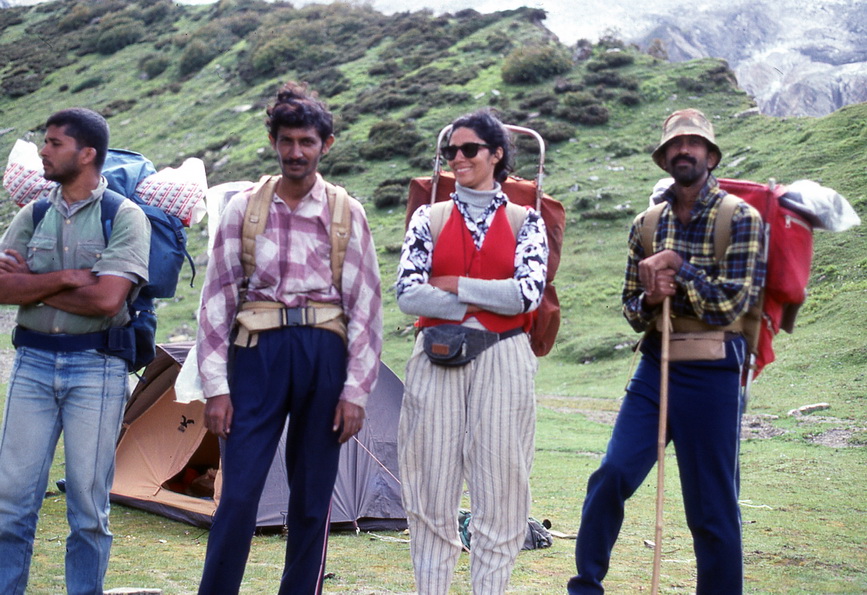
We drove the next day the short distance to Patimahal from where our walk to Base Camp would begin. Ponies were hired from Ghani Chacha ("Uncle") and our little expedition was soon on its way. Our permanent members had been boosted by the addition of Shashi, a young Nepali lad of seventeen or eighteen. I am still not clear as to how we ended up employing him as our camp cook, but he was to prove an asset to the team. If ever I had had delusions about myself being a sort of casual adventurer, Shashi's story soon put things in the correct perspective: he had run away from his home in Siliguri (at the eastern end of the Himalayan foothills) at the age of ten and had led a peripatetic life, working odd jobs like being the tea boy in roadside dhabas, finally ending up working in circuses! He had worked as a trapeze artist in the Raymond and Gemini circuses, two marquees I was familiar with when growing up. His wanderings led him to Kishtwar and when I asked him why he wanted to come along with us, he answered - "I've never been in the high Himalaya, I would just look at them from a distance all my life. This gives me an opportunity to see the snows up close!" End of interview, he was hired! To me, people like Shashi are the true adventurers in our midst, people whose life is lived like a throw of dice, who do not let mundane worries like Where is My Next Meal Coming From, or How Am I Going To Pay My Rent, bother them. They bash on regardless!

The four day approach walk to our Base Camp at the head of the Nanth Nullah was idyllic. We were briefly spared from the monsoon rains so we could appreciate the beauty of this valley. I tried to recall memories of my passage thirteen years earlier but failed. Perhaps it was all for the good: I could appreciate my stunning surroundings with fresh eyes and loved every vista that a turn in the trail presented.

The Nanth Nullah opens up to gorgeous scenery
The Mughal emperor Jahangir is said to have quoted an old Persian couplet when he saw Kashmir : "If there be a Paradise here below, this is it, this is it, this is it!"

Wading our way through meadows sprinkled with wildflowers, waterfalls cascading hundreds of feet and creating ever changing rainbow displays as the sun caught them in its rays, breathtaking glimpses of glittering snowfields perched at impossible angles high on a towering peak, breathing in the heady mountain air with each upward step, we had to admit that the emperor had a case.


The names of the settlements we passed through had poetry resonating in their names : names like Ghunghat and Sattarchin, Hawal and Haunzar, Sueda and Sonder. Kamlesh even found the time to flirt with a pretty shepherdess who was herding her flock of sheep with the help of her little sister. The girl was stunningly beautiful and totally guileless, a true child of nature. She fitted in perfectly with her fairy tale surroundings. She thought we were a pair of crazy idiots carrying our heavy rucksacks and going up to spend a couple of weeks among rocks and snow and ice. We apologised for our misguided outlook on life and  reluctantly took her leave. As she passed us by I noticed that her feet were filthy with mud.....ah well, no one is perfect! We could hear the girls' shrill voices calling out to their charges for a long time.

Village of Sonder


The tinkling of bells announced that our pack animals were catching up with us. We quickened our pace and had to stop again to admire the view ahead : the monolith of the Eiger (6000 m) dominated the skyline as we approached Mirchin, where our Base Camp was to be. On 24 August 1989 we camped on a sandy flat with a miniature lake at one end and the moraine ridge of the Brahmmah glacier on our right. The kitchen was set up under a huge boulder and Shashi got to work, passing out steaming mugs of welcome hot chai. Ghani Chacha collected his fee, rounded up his mules and ponies, and headed back down the valley. We were now alone, at the mercy of Brahma, the God of Creation.

The last lap to Base Camp


Kishtwar Eiger, 6000 m

Friday, 4 January 2013

Panch Chuli - Part II. Lessons in Humility.

"Bitter February, within and without. Mood to watch the weather; raw and overcast, near to freezing." Dick Francis might as well have been summarising our mental state, instead of launching into Chapter One of his book "Bolt".

I laid the paperback novel borrowed from Ravish down on my sleeping bag and peeked out of the tent door.   Overcast, certainly, but far removed from the jockey-author's world of racehorses and evil doings. The brilliant white glow of the Sona icefall was accentuated by the backdrop of dark grey clouds swirling among the seracs and fissures. The emerald green meadows swept up to the base of the glacier. A few stray yaks meandered high up on the slopes where their owners had left them weeks ago. Eventually, their human masters would come up from Son-Duktu and herd their precious charges down in preparation for their annual migration down the Darmaganga as winter descended from the eternal snows.

More than a week had gone by since we arrived at our first Base Camp. We had spent the subsequent days ferrying loads across the moraine of the Meola glacier to where our eventual Base Camp would be - this was exactly the same place where the Scots had pitched their Camp II in 1950. When I looked through the viewfinder of my camera, I was blown away by the similarity of the two camps, 38 years apart in time!

The Scottish camp - 1950
(Frontispiece, The Scottish Himalayan Expedition by W.H.Murray)


Our Base Camp, 1988
It was an exciting thing to be following in the footsteps of the pioneer explorers. I set aside Dick Francis' tale of dark deeds set in a faraway isle and thumbed through Murray's account :

"To each side of the summit great glaciers descended: on the left the Meola, on the right the Sona, each ending up in ice-falls four thousand feet high....Their lower halves were impossible; the upper halves, leading to the south and north summit ridges respectively, looked climbable......Between the two great glaciers a great rock ridge dropped from the summit five thousand feet eastwards. Below it, and still dividing the glaciers, stood a wide cliff. In its right hand half the cliff was three thousand feet high and towards the left two thousand.....We could see that a very steep grassy shelf slanted up the cliffs, starting just to the right of a prominent waterfall and then rising leftwards...."

Sketch map by Robert Anderson in Murray's book

Murray's original sketch enhanced by Rajesh Bathija
Our plan was to go up the slanting grass shelf and establish a camp above it. From here, our paths would separate: while the Scotsmen had explored the Sona glacier to gain access to the north col of the mountain, we were hoping to skirt the upper Meola icefall on its right hand side and find our way to the base of the southeast face. If that was possible, we would attempt one of the systems of buttresses and gullies which dropped steeply from the north ridge of Panch Chuli II.

The Scottish approach via the Sona glacier

However, man proposes, and the weather disposes. As soon as we had finished ferrying all our loads across the moraine of the Meola to what was to become our final Base Camp, the heavens opened up and the rain came down in sheets. After a couple of days of being incarcerated in our soggy tents, we decided to retreat to the relative comfort of the dilapidated schoolhouse in Duktu, to dry out. Our arrival coincided with the return of the trekking party from Sipu and the demise of a sheep which had fallen off a cliff. The owner sold us about 2 kilos of the meat and the whole team, with the exception of Jayant and Raghu who were vegetarians, feasted on this flesh over 2 meals.

When the trekkers began their journey back to Tawaghat, I decided to accompany them to Nagling to divert my mind - and to spend a few more hours with Margaret! After getting over one more farewell, I marched back to Duktu with an SPF (Special Police Force) officer and his batman. He offered me chai at their post in Baling, we exchanged names and addresses, and he invited the entire team to the SPF camp at Goh, just beyond Duktu. In the event, we never really took up his invitation.

Taking advantage of a brief spell of clear weather we hurried back to Base Camp and over the next three days had managed to find our way up over the grass shelf to a potential site for a camp at the base of the big rocky cliff which drops down from the mountain and separates the upper Meola from the upper Sona. There were faint shepherd tracks which we followed all the way to some broad gently sloping pastures which housed a rudimentary stone enclosure for sheep. The initial climb was steep but worth every gasp of breath: as we crested the last rise, stupendous views of Panch Chuli V and IV took our breath away. A little further up and Panch Chuli III came into view. Looking back to the east, the valley of the Sona dropped away to the little dots that were the twin villages of Son-Duktu, and beyond rose an impressive array of unnamed and unclimbed peaks.

The first view of Panch Chuli V as we topped out onto the first grass shelf


A little later, Panch Chuli IV (right) crept into view

Panch Chuli IV

As we ascended a rocky ramp at the edge of the Meola, Panch Chuli III was the last one to appear

Looking east we could see the ripening fields of millet and barley around the villages of Son-Duktu

Kum Kum leads the way up some ropes that we fixed to secure our route to Camp  I
The weather window proved to be short lived. Soon the rain clouds began to mobilise and we were trapped in our nylon shelters at Base Camp once again. One more week went by in a constant barrage of rain; sometimes it would be mixed with sleet. There were ominous sounds emanating from both the Meola and the Sona icefalls as masses of ice shifted and towers collapsed. One day there was  a frightening volley of rocks shooting down the grass ledges as the ridges above became unstable. Our time was spent cooking, eating, dozing, reading, and once every afternoon, at precisely 4:55 pm, listening to a special weather bulletin broadcast by All India Radio for us. We laughed when the announcer said, "....and now for a special weather bulletin for Expedition Beauty (for some unfathomable reason, this was the code name assigned to us by the Indian Mountaineering Foundation who had arranged for this special weather report)......" The report only served to confirm our miserably wet and cold state.

As I sat in my tent and listened to the patter of the rain on the tent fly, I could not help contrast this trip with my first Himalayan climb. In 1985, exactly three years ago, I had left Mumbai on the15th of August and was standing atop my first summit two weeks later, at 20,000 feet! Perhaps that was sheer beginner's luck...

We decided to retreat to Duktu once again!

Finally, on the 26th of Sept., a full month since our departure from Mumbai, Ravish and I reoccupied Base Camp. The Khadalia couple would come up a day later as Kum Kum (who is a doctor) had to attend to an old lady she had treated for a cut a few weeks earlier.

The next day, Ravish and I set off to establish and occupy our Camp I. We re-tensioned some of the ropes that we had fixed up the rock / grass gully. We were grateful for the security of the ropes as the constant rain and snow had made ascending the gully a bit of a challenge.The grass slopes at our proposed camp site were now under more than a foot of snow. We pitched one tent and hurriedly ate dinner, followed by some chocolate fudge (which Margaret had especially made back in Mumbai) to celebrate my birthday up here!

Camp I

Brahma Kamal - the Lotus of God, growing at Camp I

The Pandavas may have stopped here to cook their divine meal; as far as we were concerned, our menu was in the slow cooker and the ingredients consisted of more rain, snow, and sleet. Days went by: we managed to put in another camp and set off on a couple of reconnaissances. The prospect of actually descending into the chaos of the upper Meola to gain the col between peaks II and III was totally unattractive, to say the least. It was ridden with crevasses and behaved in an extremely fickle manner during the period of our stay. We unanimously agreed that we were not going to risk life and limb in the midst of its ice towers and crevasses. We were firm believers in the dictum : There are Bold Climbers and there are Old Climbers; but there are no Old Bold Climbers!

Camp II
We cast around to see if we could traverse on the lower slopes of the east ridge and then drop down towards the col. A brief foray revealed that the obstacles were considerable: steep rocky ridges barred the way. Our little expedition was just not geared to tackle terrain of that nature. We spent 12 days in increasingly cold and unpredictable weather and finally had to accept the fact that this approach was not practical for us. Time, and our supplies, was also running out. The last of the summer inhabitants of the Darma valley would soon be heading down to more amenable environments and we would be hard pressed to find pack animals for the trek down to Tawaghat.

Upper Meola icefall leading to the col below Panch Chuli III ( left) and II (south ridge just visible)


Ravish and I set off on one last sortie, climbing above our Camp II to see if we could traverse the steep rock  and find a viable route so we could drop down on to the relatively flat ground of the saddle between Panch Chuli II and III where a camp site looked feasible. After a couple of hours we were convinced that the climbing would be too technical for our modest talents and the route would be very strung out. As if to compensate for our disappointment, the day brought us some fantastic photo opportunities and I was glad to keep turning the film advance lever of my trusty Olympus OM1 SLR camera.

Ravish poses with the icy splendour of Panch Chuli III serving as a gorgeous backdrop

The col between the south ridge (right) of Panch Chuli II and Panch Chuli III (left)

Panch Chuli IV

Panch Chuli V

With a mixture of relief and sadness, we turned back and hurried down to camp. Our minds were now focused on the business of getting down safely to Base Camp with all our stuff. A lammergeier spotted our small and futile human movements and swooped down low, gliding a few feet above us. The wind rushing through its feathers sounded surreal. It was a magnificent bird, and the bright cold sunlight split into shafts of dynamic rays as it filtered through the massive wingspan. I think it was telling us that we did not belong, that our fragile existence was better served if we stayed down in the valleys and the plains!

Above Camp II

The view east


We were back in Duktu on the 12th October. The whole village was bustling with activity, families packing up to go down the valley, making sure their houses were locked for the winter, their harvests of millet stored in deep excavations in the ground and covered with branches and leaves and straw. Winter would soon descend onto this small hamlet and everything would be buried under the snow. When the families returned after the spring thaw they would uncover their precious cargo. By tradition, one family would stay back and keep an eye on things during the cold winter months. And the next year another family would stay behind and so the responsibility would be passed on...It was wonderful to witness this age old custom of community co-operation high in the Himalaya.

Autumn creeps down the slopes to Duktu


Because demand for pack animals was now so high, we barely managed to get some for our own move back to Tawaghat. In the end, though, everything worked out and we joined the caravan of Bhotia families: men, women, children, goats all walking down the mountain trails with ceaseless chatter and the tinkling of the bells round the necks of the mules and donkeys carrying the luggage. With our little transistor radio, we caught up with happenings in the rest of the world. The bad weather that had plagued us was not exclusive to our little area; rain and snow storms had swept all across the Himalaya that September, from east to west. One unfortunate party of 6 trekkers had even perished on a pass in the Lahul / Zanskar region. We were lucky to have been out of harm's way during that period.

The elegant form of Panch Chuli V bids us adieu as we descend down the Darmaganga

When the shadows in the steep valleys lengthened, the caravan would halt and wood smoke from the many fires would waft around the camp. The glow from the little hearths had a warm, human touch reflected in the weather beaten faces of the mountain folk huddled around them. Even though the light could not compare with the ethereal luminescence of the Pandavas' fires on the Chulis, it was a timely reminder that as mere mortals we had been privileged to spend a few weeks in some of the most gorgeous mountain landscapes in the world. And for that we were grateful.


Sunday, 16 December 2012

Panch Chuli - Part 1. The Fire of the Pandavas

It was inevitable, I should have known. A cool dry wind blew across the cultivated fields of Dhauj, causing little ripples to dance on the surface of the lake. The rocks jutted into the winter sky, catching the pale morning light and using it to illuminate their subtle shades of bleached ochres and browns.

"Do you want to lead?", asked Mohit. If I had said No then, I would not have a story to tell. I am sure it was this thing called destiny.

"Why not?" I replied eagerly, clipping the rope into my harness and rubbing my fingers to warm them up a little. The touch of the cold rock on the first handhold was reassuring as I swung up my right leg onto a fairly decent sloping ledge. A couple of more moves and the rock began to overhang. I looked up : if I could grab that hold just out of reach of my outstretched left arm; then I could swing and lever my body just enough for my right toe to jam into that crack. I looked down and could see Mohit peering up at me as he belayed me. I unclipped a camming device called a "Friend" from the sparse stock of protection gear on my rack. I pulled on the contracting lever with two of my fingers and as the cams rotated into a thinner profile I snuck them up the crack above and slightly to my right and then let go to allow the cams to expand and their hard, serrated titanium edges to bite into the sides of the crack. I tugged at the Friend. It did not budge; it seemed secure and firmly seated. I clipped the rope into the carabiner that was attached to the Friend with a small webbed loop of nylon tape. I pulled on the two sections of the rope which now looped down. Nothing moved. Reassured that my protection was secure, I began to move upwards and leftwards, past the Friend. The rope slid smoothly through the carabiner. No problem there, I told myself.

I lunged for a hold on the overhang to my left, slapped the smooth marble like rock with my fingers and hung briefly, my right foot scrabbling for purchase on the rock which rose like an unforgiving wall near my waist. Even the "sticky" rubber of my rock climbing shoes failed to adhere to the rock and my foot slipped. My left arm gave in, my fingers parted company with the rock and I fell like a stone. For a nanosecond I thought the Friend would break my fall. Incredulously I watched it fly out from the crack and I knew instantly that this could be the end.

I hit the hard rocky ground with a resounding thud and blacked out. When I regained consciousness a couple of minutes later my back hurt and a thin trickle of blood was flowing out from the right hand side of my mouth. Mohit was beside me, yelling out my name, glad to see I was still alive. I must have fallen from about twenty five feet or so and was fortunate that I had not landed head first. I had instinctively curled myself up as I landed and avoided injury to my skull. I had bitten my tongue inadvertently with the jarring impact and that was the blood that Mohit saw. He summoned a man who was herding a camel nearby. He brought some water from the lake and I sipped it slowly. The initial shock began to wane. They helped me to sit up and a little later Mohit helped me to stagger to my feet. He made some inquiries from the camel herder and armed with the knowledge that there was a primary health centre in the village of Dhauj, we set off. The pain in my ribs was excruciating and I was sure I had broken a couple. With my arm on Mohit's shoulder, I hobbled along the narrow pathways between the fields of wheat waving seductively in the wind.

The little room that served as the Sunday clinic was full of villagers seeking medical advice and help on one of the few days in the week that they actually got to see a physician. I felt guilty to take up one of their precious spots : here I was, suffering from the aftermath of a personal and selfish indulgence, in a place full of   simple folk who went about their daily lives and who had to deal with their ailments and illnesses without much access to medical care. The good doctor who saw me had obviously taken the Hippocratic oath in its true spirit and compassionate sweep because he refrained from making any remarks about crazy people from the city who scrambled over some rock outcrops for entertainment.

Mohit's guide book

Fortified with a pain killing injection I hopped onto the rear seat of Mohit's Bajaj scooter as he kicked the starter and we puttered out of Dhauj and onto the road to New Delhi, an hour and a half away. That bumpy, dusty ride on the back of that Bajaj will remain burned in my memory as one of the most painful that I have had to endure, not because of any deficiency on the part of Mohit's riding skills, but because the pain that shot through my chest each time we hit a bump was excruciating, to say the least. I had to fight to remain conscious.

As my ribs healed over the next few weeks in Mumbai, I had a lot of time to think things through and ponder the future. This was February 1988, exactly three years since the last time I had almost died, falling off the cliffs at Mumbra ( see my earlier post http://taccidental.blogspot.ca/2012/06/mayhem-at-mumbra.html). Once again I had time on my hands and once again an idea began to form in my head and once again, not surprisingly, I began scheming. T.E.Lawrence (made famous as Lawrence of Arabia in David Lean's sweeping epic of a movie) wrote : "All men dream, but not equally. Those who dream by night in the dusty recesses of their minds, wake in the day to find that it was vanity; but the dreamers of the day are dangerous men, for they may act their dream with open eyes, to make it possible." Margaret, my long suffering wife, would have agreed. But I was going to get round that problem by including her in the dream!

Helping to coalesce vague desires into some form of objective was a book by W.H.Murray : The Scottish Himalayan Expedition. I reread this enchanting tale of exploration and high adventure in the Garhwal and Kumaon Himalaya in 1950 by a small team of climbers who spent three months in the then largely unexplored valleys and mountains of this part of the range. Towards the end of their expedition they had attempted to climb the 6904 m Panch Chuli II, the elegant and highest of a cluster of five peaks. They had failed to reach the summit but had paved the way for later climbers. A large and well organized team from the ITBP (Indo Tibet Border Police) finally claimed the first ascent in 1973, reaching the summit in classic siege style, from the western approaches to the mountain.

L to R : Panch Chuli V, IV, III, II as seen from Duktu in the Darma valley.
Panch Chuli II is the highest of the group at 6904 metres.

Casting around for like minded dreamers, I sounded out Jayant and Kum Kum Khadalia and when they said yes I was thrilled. Their friend Ravish Puri was also interested. A month earlier, we had spent some time rock climbing at Mt. Abu in Rajasthan and found that we shared the same outlook on climbing and expeditions. Margaret, Mohan, Franklyn and Raghu would make up a trekking team who would accompany us to Base Camp. Thus Panch Chuli 1988 was born : we were hoping to make some progress on the mountain from the eastern approaches.....in the footsteps of the Scottish team and in a lightweight fashion.

We left Mumbai for Delhi at the end of August. The noise and apparent chaos of the ISBT (Inter State Bus Terminus) was by now a familiar experience after a couple of previous transits through there. The overnight service took us to Tanakpur where we transferred to another bus which would take us away from the muggy plains and up to the cool hills of Kumaon. I have always enjoyed these journeys which take you through a changing landscape in the space of a few hours, from the lower moist tropical forests to the cool and dry elevations where the chir pine and the deodar rule. As opposed to flying into the mountains which transports you perhaps too quickly to truly assimilate and appreciate the change, an approach by road allows the soul to gradually soak in the wonders of a changing environment.

While most people doze (or throw up) as the small hill buses grind their way up endless switchbacks and U-turns, I always sit glued to a window seat, watching in delight as the almost treadless tires splash through pebble bottomed streams, the occasional bright coloured bird flits in the shadowy recesses of the trees. I  listen to the music inevitably blaring from the driver's little cassette player sometimes taped to the dashboard. The driver is also usually talking non-stop to a buddy or some passenger seated in the front and if you listen carefully there are always gems of information to be gleaned from their seemingly trivial chatter: you might pick up the latest info on road conditions further up in the mountains, of bridge closures, landslides, local politics..... I have always admired the stamina and patience of these hill drivers as they constantly swing the steering wheel one full revolution clockwise followed by another full revolution anti-clockwise. They are invariably courteous and allow all traffic going uphill right of way and extend a cheery greeting and exchange information through the open windows when they pass their colleagues driving another bus. And so it goes on for hours till he stops at a welcome tea stall where everyone gets off the bus just to stretch their legs or to have a bite. The male passengers also usually line up at convenient locations to pee; I have to admit that I am as guilty as the rest of my gender! The women seem to have better control of their bladders, perhaps a result of generations of cultural and environmental evolution...

This was my first visit to the Kumaon Himalaya and I revelled in the relatively uncrowded roads, devoid of tourist hordes - of course this was 1988, more than 24 years ago!

We arrived in Pithoragarh in the afternoon and immediately checked into the Tourist Rest House where the views were magnificent, the food was great and the tariff was only Rs.25 per double room! We obtained a permit to buy kerosene and another permit to enter the town of Dharchula, our next stop. Yes, those were the days of fuel rationing and the dreaded Inner Line Permit! The main hurdles to mountaineering were encountered well before one ever set foot on the mountain.

Leaving Pithoragarh at 5 am, we were in Jauljibi in time for a breakfast of parathas and tea. This is also where our permit for Dharchula was checked. At Dharchula, new permits were to be issued at the Sub Divisional Magistrate's office. When we arrived at the office, it was closed for lunch. Half the team proceeded to Tawaghat, while the rest of us hung around the magistrate's office for his minions to return from their lunch break. We were given the usual time consuming run around in that dusty office stacked with files from a hundred years ago and serving as cobweb anchors. The petty official who was typing out our permits was agonizingly slow on his rickety machine. I suggested gently that I might be able to relieve him of this tedious task. He readily agreed and I hammered out our permits in a fraction of the time it would have taken him, even though I am no wiz on the keyboard.

The roar of the Dhauli Ganga hurtling past the PWD Rest House at Tawaghat lulled us to sleep. It had taken us four days from Mumbai to get here; but the show was finally on the road! The jeepable road continued for another 17 km to Sobala, but we were going to start walking. We had concluded negotiations with a muleteer for 6 mules to carry our baggage to Base Camp. The rate agreed upon was Rs. 80 per day per mule. Each mule could carry about 65 kilos. We would be relatively lightly laden, our rucksacks weighing between 20-25 kg each, just enough to get us fit by the time we arrived at the base of the Chulis.


Tawaghat is only 3700 feet above sea level and even though the waters of the Dhauliganga are cold here, it does not really have an alpine ambience. We were only too happy to start walking on the jeep road on the first day of September and in four hours were at the village of Nyu, 1800 feet higher. The scenery was quite good, there were many waterfalls to admire along the way, and tea stalls almost on the hour. It was a great way to warm up for the weeks ahead. The rest house at Nyu was quite nice and there was a tented SPF (Special Police Force) camp next to it. A little drizzle followed dinner and we were glad to be sleeping indoors. Raghu, who had not been feeling too well all day had to be sedated to sleep.

It is strange what things get jotted down when you keep a journal. In my entry for 2nd Sept 1988, written in the evening of that day at Sela, I had jotted down : "Immediately after leaving Nyu, we passed Sobla where a loud fight between a husband and wife was going on...."

Notwithstanding such domestic strife, the walk was a delight: dark green forested hillsides drenched occasionally by waterfalls, a lunch stop which served up a very tasty potato bhaji, with fiery red chillies. There were rhododendron trees and dwarf bamboo lining the trail later, so we could sit in their shade and doze a little to help the digestion!

Margaret and I on the track from Nyu to Sela

As is usual in the Himalaya, we were soon out of the narrow entrance valley of the Darmaganga on day three of our walk. The vistas opened up to the high mountain pastures and seasonally cultivated fields, carved out by generations of hard working Bhutias who inhabit these settlements in the summer months. Soaring up and above these were the craggy cliffs that girdled the bases of scores of named and unnamed peaks, some of their impossible summits rearing defiantly into the azure blue skies.

Looking back down the Darma valley to the small settlement of Baling
We spent the night in the gorgeously located village of Duktu. With its twin Son, just across the river from which it takes its name, this has to be the best viewpoint to see all the five summits of the Panch Chuli group from the east.

At 10 am on Sunday, 4 Sept. we arrived at our Base Camp, after a mere two hour walk from Duktu. While we busied ourselves pitching tents and paying off Mahinder Singh (the muleteer), a group of young girls and women who had accompanied us from Duktu set off merrily up the surrounding steep grassy slopes, laughing and chattering like a flock of Himalayan green finches we were to see much of later. They returned a couple of hours later, carrying huge loads of medicinal herbs with a tumpline. They would sell these precious herbs to a middleman who would then pass them on to a local wholesaler who in turn would sell them for a handsome profit to a representative of some pharmaceutical company. I am sure these wonderful ladies would have loved to have something like a co-operative movement which would have rewarded them more fairly for risking life and limb on these precarious slopes in the shadows of the Chulis.

Franklyn and Mohan on the trail from Duktu to Base Camp

After the excitement and relief of having arrived at our destination subsided, we realized that the muleteer had deposited us on the wrong side of the glacier! Hurriedly going through our copies of the Scottish expedition and subsequently the attempt by Graaf and Snelson, it dawned on us that our Base Camp should have been on the true left bank of the Meola glacier. Ah well, we reasoned, we could remedy that by ferrying loads across the moraine and establish our Real Base Camp! This would also serve to familiarize ourselves with the terrain and become fitter.

In the meantine, we enjoyed the company of our trekking party who were soon to depart for Aanchri Tal further up the Darma valley.

The trekkers leave Base Camp for Aanchri Tal. L to R : Mohan, Franklyn, Margaret, Raghu.


The route to Camp I 

There is a legend about the Pandava brothers of the Mahabharat : they are said to have halted at the five peaks of the Panch Chuli group (so each could have his own little summit, I guess.) on their way to heaven and cooked their evening meal. Thus, when the alpen glow turns the snows of the Panch Chuli into a fiery red in the light of the setting sun, it is easy to believe that this could be true.

For our part, we turned to our humble portable stoves to cook our dinner. Raghu scouted around the camp for bits of dead juniper wood and lit a bonfire over which he toasted papads, a favourite pastime of his when camping. The wood crackled and gave off sparks and the heady scent of juniper filled the air. In the night, there were rumbles and explosions in the air : the Meola icefall was flexing its muscles and we were to get used to its nightly groans for the full duration of our stay.

From the comfort of 12,000 ft. we could see the summit of Panch Chuli II : more than 10,000 feet higher and a couple of miles away, it seemed icy and remote. Would it allow us to set foot on one of the ribs on its south east face we were contemplating? We had budgeted almost six weeks for our forays above Base Camp and were confident that this would be sufficient. But first we had to shift our Base Camp right across the moraine of the Meola...

Panch Chuli V - 21,120 ft.